
Within Enhanced Recovery After Surgery (ERAS), carbohydrate drinks are routinely used before many major surgical procedures to reduce postoperative insulin resistance and improve recovery.
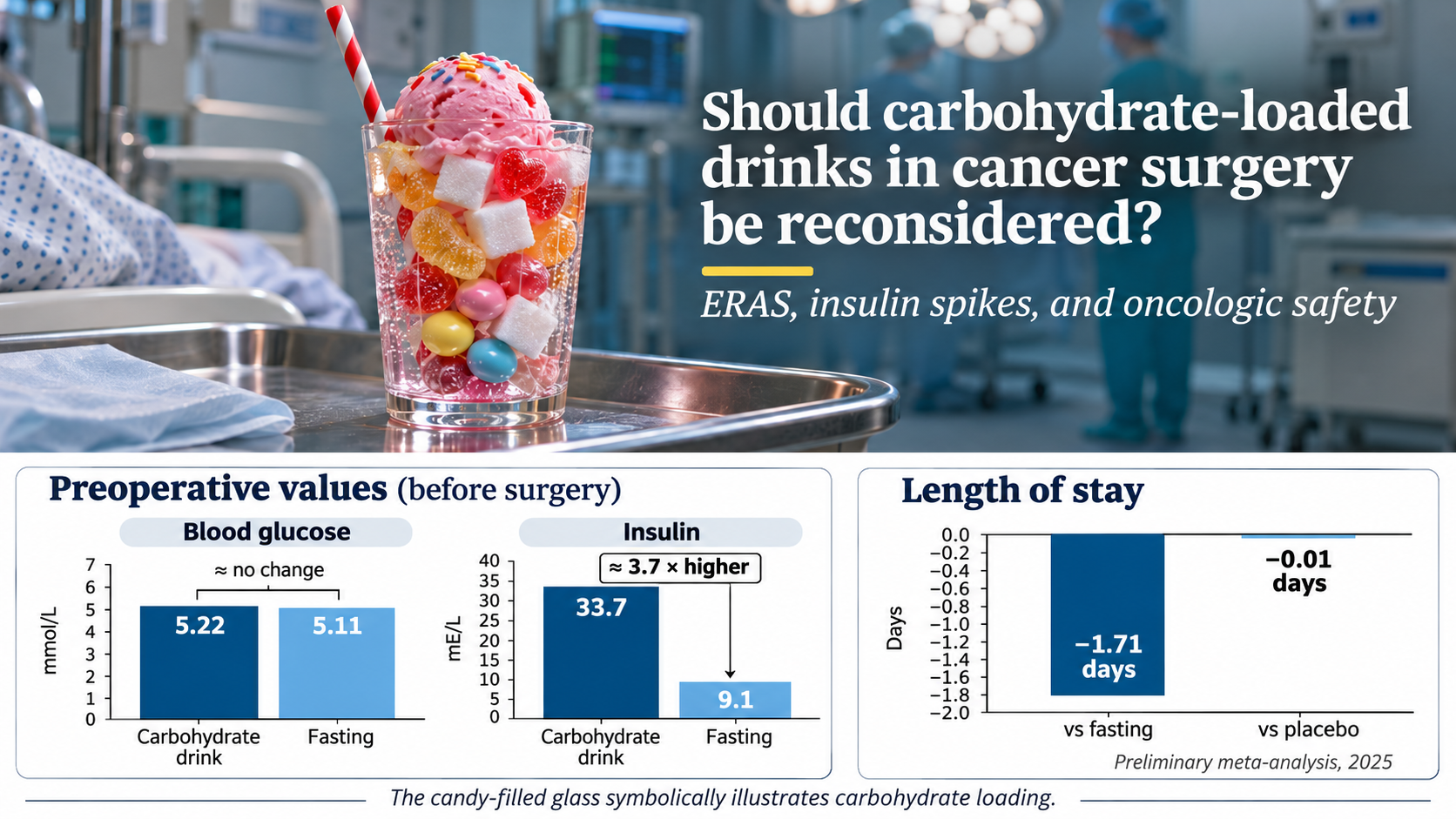
However, in the updated 2025 ERAS guidelines for colorectal surgery, the recommendation for carbohydrate loading was downgraded from strong to weak. Despite improved insulin sensitivity, no clear clinical benefits had been demonstrated compared with modern, shorter fasting protocols.
But is carbohydrate loading really as justified in cancer surgery as in other surgical procedures?
As I described in two previous blog posts, a Norwegian randomised breast cancer study from 2019 found that preoperative carbohydrate loading resulted in nearly fourfold higher insulin levels. The researchers also observed higher proliferative activity and poorer recurrence-free survival in a subgroup of patients.
The study was too small to establish a causal relationship, but its findings should be taken seriously.
As early as 2021, Haskins and colleagues highlighted in their review, Low Carbohydrate Diets in Cancer Therapeutics: Current Evidence, that preoperative carbohydrate loading may be beneficial from a surgical perspective but potentially counterproductive from an oncological perspective.
Are the carbohydrates really necessary?
A preliminary meta-analysis presented in 2025 reported the following results:
| Comparison | Change in length of stay | 95% confidence interval |
|---|---|---|
| Carbohydrate drink vs traditional fasting | −1.71 days | −3.04 to −0.38 |
| Carbohydrate drink vs placebo | −0.01 days | −0.16 to +0.16 |
Compared with placebo, the difference in length of stay was therefore only about 14 minutes. The confidence interval also argues against any substantial average difference in length of stay.
In the research group’s final publication, fasting and placebo were analysed together, with an average reduction in length of stay of 0.56 days.
At the same time, there is scientific evidence that carbohydrate loading improves postoperative insulin sensitivity. The question is how this metabolic benefit should be weighed against the potential oncological disadvantages in cancer surgery.
My reflection
Against this background, I believe that the routine use of carbohydrate loading in cancer surgery should be reconsidered.
Why expose cancer patients to a marked rise in insulin while the tumour is still present, when comparable lengths of hospital stay appear achievable without carbohydrate loading?
The Norwegian study does not prove that the intervention worsens cancer prognosis, but it provides a warning signal that warrants further investigation.
I believe that those who recommend routine carbohydrate loading in cancer surgery should also be able to provide satisfactory evidence of its oncological safety.
Absence of evidence of harm is not the same as documented safety.
In cancer surgery, we should not only optimise recovery in the days following the operation, but also consider the cancer prognosis in the years that follow.
Previous blog posts
A particularly sad Norwegian story about breast cancer…
The best prepared wins – but who is the winner?
Scientific references
Lende et al. 2019 – Preoperative carbohydrate loading and breast cancer.
Haskins et al. 2021 – Low Carbohydrate Diets in Cancer Therapeutics: Current Evidence.
2025 meta-analysis – Conference abstract P029.
2025 meta-analysis – Final publication in Scientific Reports.
ERAS Society – Updated guidelines for colorectal surgery, 2025.
This research note discusses clinical guidelines and is not a recommendation for patients to disregard their healthcare team’s instructions before surgery.
Comments
How your comment is handled
Linbro Therapeutics AB is responsible for comments. Your display name, text and date are published if your comment is approved. Your ChatGPT identity is used for sign-in and spam prevention, but is not shown publicly. Pending comments are deleted within 90 days. Approved comments remain until removed or the comment service is discontinued. Do not include sensitive health information. Contact sture.hobro@linbrotherapeutics.com to request removal or ask about how comments are handled.