
In sport, carbohydrate loading is used to prepare the body for a demanding event. In surgery, carbohydrate drinks are used to improve patients' metabolic condition before an operation.
But when the patient has cancer, another question arises: which cells are we actually helping to prepare for surgery?
During cancer surgery, all visible tumour is removed if the operation goes as planned. This does not mean that every cancer cell disappears.
Many patients already have disseminated cancer cells at the time of surgery. In a large study of breast cancer patients, researchers detected tumour cells in the bone marrow of just over 30%, despite no clinically established distant spread.
Research also shows that circulating tumour cells can increase around surgery. In one study, the proportion of breast cancer patients with detectable tumour cells in the blood rose from 45% to 66% on the first postoperative day.
Most circulating tumour cells never form metastases. But some can survive, remain dormant for a long time and later cause recurrence.
For a patient's future, these few surviving cells may matter far more than the billions of cancer cells removed during surgery.
Surgery changes the playing field
Removing the tumour dramatically changes the environment.
Blood supply changes, tissues are injured, inflammatory processes are activated and healing begins.
Remaining cancer cells must adapt to these new conditions.
Which survive?
This depends partly on their energy supply, nutrient availability, antioxidant defences and ability to resist programmed cell death — apoptosis.
This is where insulin enters the picture.
Insulin — much more than blood glucose regulation
Insulin is not simply a hormone that lowers blood glucose.
It is also a powerful signal for nutrient uptake, growth and survival.
Through pathways including PI3K–AKT–mTOR, insulin stimulates nutrient uptake, protein synthesis and other processes that help cells grow and survive.
Even cancer cells relying mainly on fuels other than glucose can respond to insulin's growth signals.
Insulin can therefore stimulate both nutrient uptake and the signals helping a cell grow, adapt and survive.
What happens if we sharply raise insulin just before surgery?
In a 2019 Norwegian randomised study, women with breast cancer either received 96 grams of carbohydrates before surgery or followed standard preoperative fasting.
The result was remarkable.
Blood glucose differed by only around 2% between groups.
Insulin, however, was 270% higher in patients receiving the carbohydrate drink.
This is a striking difference.
Researchers also found differences in tumour growth markers and higher glutathione levels in oestrogen receptor-positive tumours.
Glutathione is an important component of antioxidant defence, helping cells manage oxidative stress.
Large survival differences were also observed at long-term follow-up in a small patient subgroup.
Read Lende and colleagues’ randomised breast cancer trial (2019) ↗
What if we are preparing the wrong cells?
Here is my hypothesis.
It has not yet been tested directly, but builds on established knowledge of insulin's effects on cellular metabolism, growth and survival.
We know that tumour cells can remain after surgery. We also know that insulin can stimulate nutrient uptake, growth and survival signalling.
What if a sharp preoperative insulin rise helps remaining cancer cells cope with the stress and changes accompanying surgery?
Conversely, an environment with low insulin would involve weaker growth and survival signalling.
The question is not whether the tumour grows less over a few hours.
It is which cells survive when conditions change.
Individual surviving cancer cells can have profound long-term consequences.
The Norwegian study does not prove this hypothesis. Its findings nevertheless give reason to investigate this mechanism.
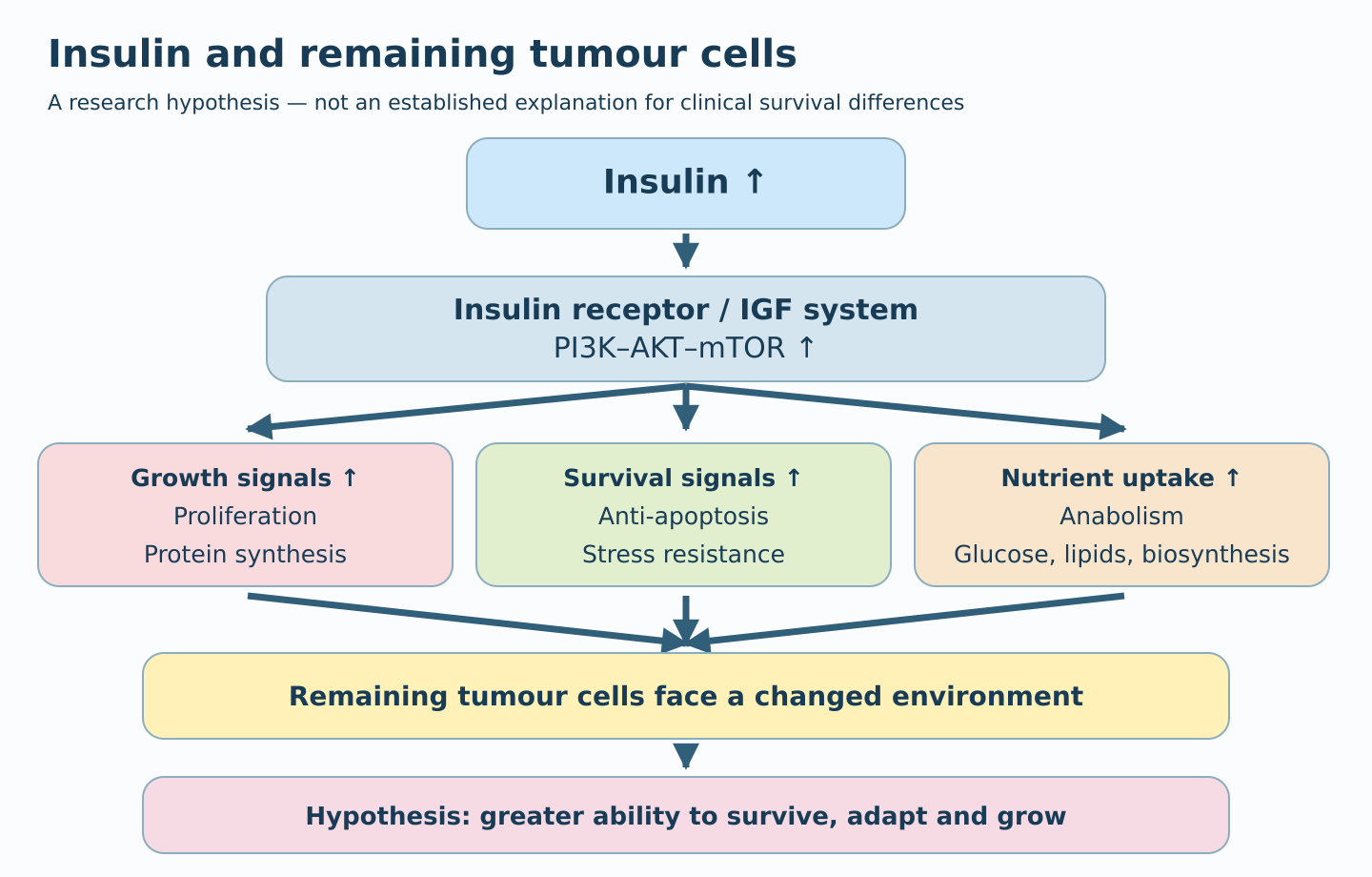
Hypothesis: elevated insulin around cancer surgery may amplify growth, nutrient and survival signalling. Could this metabolic environment also help remaining tumour cells adapt and survive? This mechanism has not been shown to explain the survival findings in the Norwegian study.
We are trying to stimulate insulin — but in which cells?
Perhaps the most interesting point is that the insulin rise is not merely an unintended consequence of the drink.
The 2025 ESPEN international surgical nutrition guideline recommends carbohydrate loading before major elective abdominal surgery, partly to stimulate insulin release, counter postoperative insulin resistance and improve recovery.
The guideline also covers cancer surgery.
Stimulating insulin before major surgery is therefore a deliberate metabolic strategy.
But insulin's anabolic signals do not reach only healthy cells.
They can also affect cancer cells remaining in the body.
If we aim to help the patient's cells cope with surgical stress, but simultaneously help remaining cancer cells survive the same stress, is this really optimal?
We do not yet know whether this happens. I believe the question deserves much more attention.
How would I approach this personally?
If I were facing cancer surgery, I would strongly question routine carbohydrate loading and discuss alternatives with the surgical and anaesthetic team.
I would also want to explore keeping insulin low through a carbohydrate-restricted or ketogenic diet around surgery, without compromising energy, protein or other nutritional needs.
This is especially important in patients already vulnerable because of malnutrition, which is not uncommon before major cancer surgery.
Keeping insulin low is not the same as starving the patient.
Wound healing, immune function and muscle maintenance require adequate nutrition.
We therefore need to develop and investigate nutritional strategies considering both recovery and tumour biology.
My hypothesis is not a proven way to reduce recurrence. But I believe it is interesting enough to justify randomised clinical studies of insulin responses, tumour biology, recovery and long-term survival.
The best prepared wins — but who is winning?
We devote substantial resources to preparing patients and improving recovery.
That is, of course, important.
But should we not also investigate how these preparations affect tumour cells?
If a few remaining cancer cells can determine whether disease returns years later, limiting their ability to survive may be at least as important as improving short-term recovery.
We want to give patients the best possible conditions.
But are we sure we are not simultaneously giving cancer cells better conditions too?
Sture Hobro
Linbro Therapeutics AB
References and further reading
1. Lende TH et al. (2019). Influence of pre-operative oral carbohydrate loading vs. standard fasting on tumor proliferation and clinical outcome in breast cancer patients – a randomized trial. BMC Cancer. Read the study
2. Lende TH et al. (2019). Metabolic consequences of perioperative oral carbohydrates in breast cancer patients – an explorative study. BMC Cancer. Read the study
3. Braun S et al. (2005). A pooled analysis of bone marrow micrometastasis in breast cancer. New England Journal of Medicine. Read the study
4. Circulating tumour cells at baseline and late phase of treatment provide prognostic value in breast cancer (2021). Scientific Reports. Read the study
5. Dormancy in Breast Cancer (2023). Read the article
6. Weimann A et al. (2025). ESPEN guideline on clinical nutrition in surgery – Update 2025. Clinical Nutrition. Read the guideline
7. Ligibel JA et al. (2022). Exercise, Diet, and Weight Management During Cancer Treatment: ASCO Guideline. Journal of Clinical Oncology. Read the guideline
This article presents a research hypothesis, not an established treatment. Dietary and fasting routines before surgery should not be changed without consulting your care team.
Comments are public. Please do not include sensitive health information about yourself or others. Comments are reviewed before publication.
Comments
How your comment is handled
Linbro Therapeutics AB is responsible for comments. Your display name, text and date are published if your comment is approved. Your ChatGPT identity is used for sign-in and spam prevention, but is not shown publicly. Pending comments are deleted within 90 days. Approved comments remain until removed or the comment service is discontinued. Do not include sensitive health information. Contact sture.hobro@linbrotherapeutics.com to request removal or ask about how comments are handled.