
A Norwegian randomised study from 2019 produced some striking findings.
Patients given 96 grams of carbohydrates before breast cancer surgery had almost four times the insulin levels of patients who fasted — despite virtually identical blood glucose.
Researchers also found differences in tumour growth markers and higher levels of glutathione, which helps cells defend themselves against oxidative stress.
The most surprising findings, however, emerged at long-term follow-up.
Among patients with oestrogen receptor-positive breast tumours measuring 2–5 cm, overall survival was 33% in the carbohydrate group versus 100% in the fasting group.
The difference is remarkable, although the subgroup comprised only eleven patients — six receiving carbohydrates and five fasting — and the carbohydrate group had a higher proportion of tumours with unfavourable prognostic features.
Despite these findings, carbohydrate loading is still recommended before certain cancer operations.
This raises a question I believe deserves much more attention:
When trying to create the best conditions for a patient's recovery after surgery, have we also investigated the conditions we are creating for the tumour?
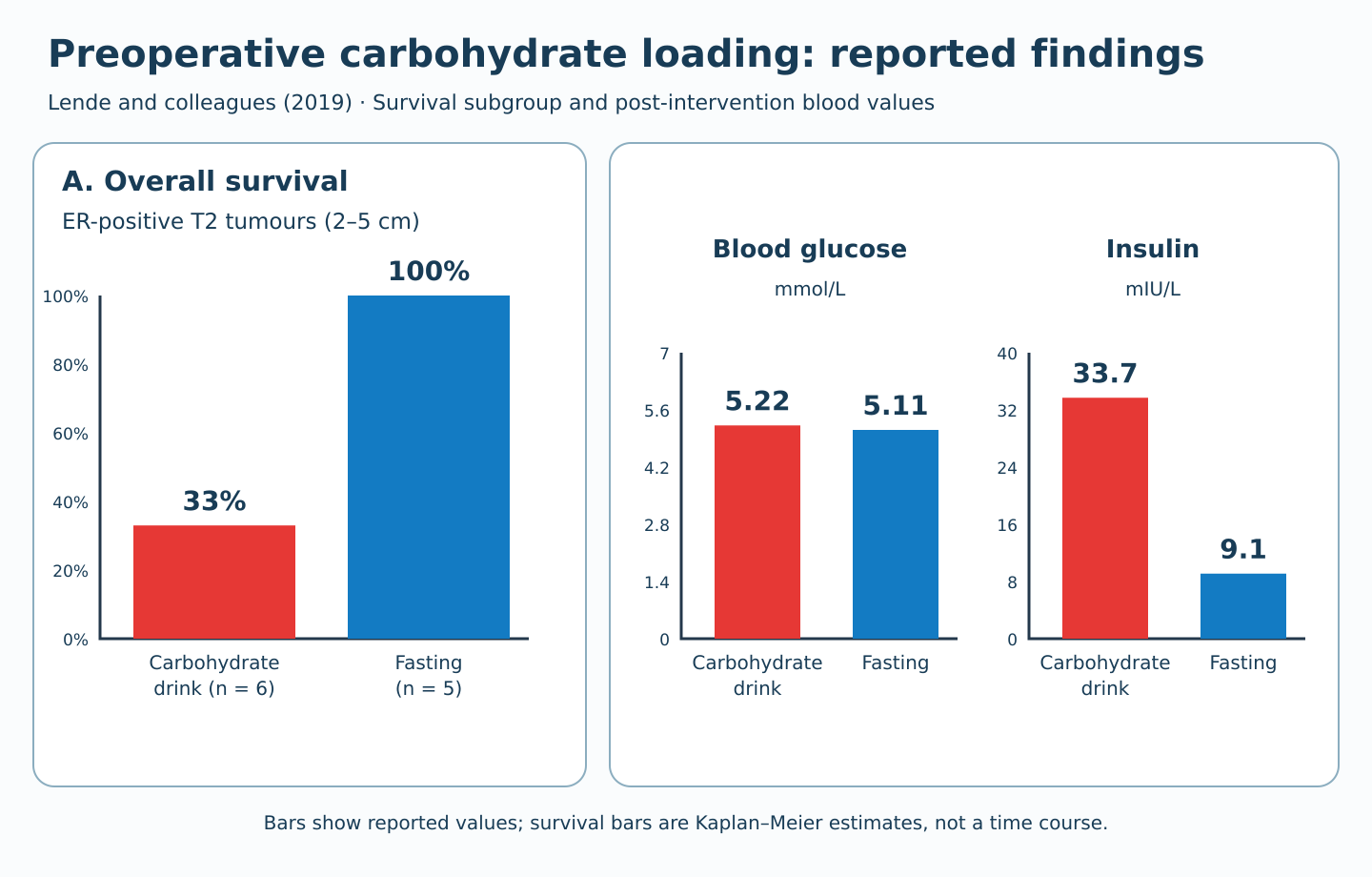
Figure 1. Carbohydrate loading before breast cancer surgery. (A) Overall survival in patients with oestrogen receptor-positive T2 tumours (2–5 cm). Kaplan–Meier-estimated survival was 33% in the carbohydrate group (n = 6) and 100% in the fasting group (n = 5). Bars show the reported survival estimates, not the course over time. (B) Blood glucose and insulin after the preoperative intervention. Despite almost identical blood glucose, insulin was approximately 3.7 times higher after the carbohydrate drink. Source: Lende and colleagues (2019), figure 5b and table 4.
Read Lende and colleagues’ randomised breast cancer trial (2019) ↗
Almost identical blood glucose — but 270% higher insulin
Perhaps the study's most interesting finding concerns not survival, but what happened to patients' metabolism before surgery.
Researchers measured blood glucose and insulin after the preoperative intervention.
| Blood measure | Fasting | Carbohydrate drink | Difference |
|---|---|---|---|
| Glucose, mmol/L | 5.11 | 5.22 | +2% |
| Insulin, mIU/L | 9.1 | 33.7 | +270% |
A difference of only 2% in blood glucose was accompanied by a 270% difference in insulin.
This matters.
Blood glucose is regulated very effectively. Carbohydrate intake stimulates insulin release, helping keep glucose within a relatively narrow range.
But insulin does more than regulate blood glucose. It is also a growth signal affecting pathways such as PI3K–AKT–mTOR, which are important for cell growth and survival.
Two patients may therefore have almost identical blood glucose while being in very different hormonal and metabolic states.
Blood glucose tells only part of the story. Apparently normal glucose levels may conceal large differences in insulin and the signals affecting cell growth and survival.
This is one of the Norwegian study's most important lessons.
Why give carbohydrates before surgery?
Modern surgery often follows Enhanced Recovery After Surgery (ERAS) principles.
The aim is to reduce complications, shorten hospital stays and speed recovery.
These programmes may include carbohydrate-rich drinks before surgery.
The goals include reducing surgery-related insulin resistance and improving patient comfort.
The approach was developed primarily for major operations and has been used in abdominal surgery, among other fields.
Cancer surgery, however, differs from many other operations.
When the carbohydrate drink is given, the tumour is still in the body.
The question is therefore not only how the patient's metabolism is affected, but also how the tumour responds.
This is what the Norwegian group at Stavanger University Hospital wanted to investigate.
The Norwegian study — 61 women with breast cancer
Tone Hoel Lende and colleagues published a randomised study in BMC Cancer in 2019.
It included 61 women with operable breast cancer, randomly allocated to two groups.
Carbohydrate group — 26 patients
Patients received a carbohydrate-rich drink the evening before surgery and 2–4 hours before the procedure.
A total of 96 grams of carbohydrates was given.
Fasting group — 35 patients
Patients followed standard preoperative fasting routines, with free access to water.
Researchers assessed insulin, glucose, tumour growth markers and long-term clinical outcomes.
Median follow-up was 88 months — just over seven years.
Carbohydrate loading and tumour growth
One of the clearest effects was the pronounced rise in insulin.
Researchers also examined proliferation markers, which indicate how actively cells are dividing.
Among patients with oestrogen receptor-positive (ER-positive) breast cancer, 70% of tumours in the carbohydrate group had high proliferation, compared with 30% in the fasting group.
The difference was statistically significant, p = 0.038.
This suggested that the preoperative metabolic environment might influence tumour biology.
Because proliferation had not been measured before the intervention, we do not know how much of the difference was already present at randomisation.
Nevertheless, the findings were sufficiently interesting for the researchers also to investigate long-term outcomes.
The striking findings — recurrence and survival
Large differences emerged at long-term follow-up.
Among patients with ER-positive breast cancer, relapse-free survival was around 70% in the carbohydrate group versus close to 100% in the fasting group.
The difference was statistically significant, p = 0.012.
Researchers then examined the role of tumour size.
Among patients with ER-positive T2 tumours — larger than 2 cm but no larger than 5 cm — the difference was even more pronounced.
Relapse-free survival was:
- 33% in the carbohydrate group (2 of 6 patients).
- 100% in the fasting group (5 patients).
Overall survival was also 33% versus 100% in this subgroup.
This is a striking result after a metabolic intervention lasting less than one day.
But the patient groups were not fully comparable
There is an important objection to interpreting the survival differences as a direct consequence of carbohydrate loading.
Despite randomisation, the carbohydrate group had more tumours with unfavourable prognostic features.
Mean tumour size was 19.4 mm in the carbohydrate group and 15.0 mm in the fasting group.
The proportion of T2 tumours was also higher in the carbohydrate group.
These differences can themselves affect recurrence and survival.
Furthermore, the striking T2 subgroup contained only six carbohydrate-group and five fasting-group patients.
The study was originally designed to examine tumour proliferation, not to establish survival differences reliably.
The survival differences are therefore remarkable, but the study does not prove that the carbohydrate drink caused them.
This does not make the measured insulin and tumour metabolic-marker differences less interesting.
A second study investigated tumour metabolism
In December 2019, the same group published another paper based on material from the same patients.
This time, metabolic changes were investigated in more detail.
Blood samples and tumour tissue were analysed using magnetic resonance-based metabolomics.
Tumour material was available from 29 patients: 16 who received the carbohydrate drink and 13 who fasted.
Several clear differences were found.
In blood:
- Higher lactate.
- Higher pyruvate.
- Lower ketone bodies.
- Changes in several amino acids and other metabolites.
In tumours:
Glutathione levels were higher after carbohydrate loading in patients with ER-positive tumours.
The difference was statistically significant, p = 0.002.
There was also a clear positive correlation between blood insulin and tumour glutathione concentration, r = 0.680.
Read Lende and colleagues’ metabolic follow-up study (2019) ↗
Why is glutathione so interesting?
Glutathione is central to cellular antioxidant defence.
It helps cells handle reactive oxygen species and protects important structures from oxidative damage.
This defence is also particularly important for cancer cells.
Radiotherapy and several chemotherapy drugs partly rely on oxidative damage to attack tumour cells. Effective antioxidant defences may therefore help tumours survive such treatment.
Higher insulin in the carbohydrate group and higher glutathione in ER-positive tumours are consequently of particular interest.
Researchers also found associations between higher levels of certain metabolites and poorer long-term outcomes.
The metabolic analyses measured concentrations, not rates of tumour energy production. Nevertheless, they showed that the groups had different metabolic profiles.
These findings strengthen the case for investigating how a brief change in glucose and insulin conditions affects cancer around treatment.
Could a few hours of carbohydrate loading affect survival years later?
This may be the study's most fascinating question.
Carbohydrate loading lasted less than a day. Recurrence and survival differences emerged during long-term follow-up.
It seems unlikely that the tumours could have grown much during those few preoperative hours.
One possible explanation is that the altered metabolic environment affected tumour cells' ability to survive the stress of surgery.
Insulin affects growth signalling and glucose metabolism. Glutathione affects antioxidant defence.
Both matter for cell survival.
This is a biological hypothesis, however. The studies do not show that these particular mechanisms caused the differences in recurrence and survival.
Larger randomised trials are needed to resolve this.
What helps a patient's recovery is not automatically beneficial for tumour biology or long-term cancer outcomes.
Carbohydrate loading is still recommended in cancer surgery
Perhaps most remarkably, carbohydrate loading continues to be recommended in cancer surgery.
The updated 2025 ESPEN surgical nutrition guideline recommends preoperative carbohydrates before major elective abdominal surgery.
The goals include stimulating insulin release, reducing postoperative insulin resistance and improving patient comfort.
The guideline also covers surgical patients with cancer.
The 2026 ERAS gynaecological oncology guideline likewise recommends preoperative carbohydrate loading, citing improved comfort and faster recovery of bowel function.
But what happens to the tumour? And to the long-term risk of recurrence?
These are the questions raised by the Norwegian study.
Read the ESPEN surgical nutrition guideline (2025) ↗
Read the ERAS gynaecological oncology guideline (2026) ↗
Read the ERAS colorectal surgery guideline (2025) ↗
Why have the findings not been followed up?
The Norwegian study was published back in 2019.
Researchers reported large recurrence and survival differences in certain patient groups, alongside clear differences in insulin and tumour metabolic markers.
They themselves proposed a larger multicentre study.
Yet seven years later, despite searching thoroughly, I have found no published randomised study directly attempting to confirm these findings. Do we want to know?
I think that is a legitimate question.
The original study was small, and survival outcomes may have been affected by differences in tumour characteristics. But the other findings are also striking.
Is that not precisely a reason to conduct a larger trial?
The intervention is, in principle, straightforward to study: a carbohydrate drink versus standard preoperative fasting.
Both approaches are already used in healthcare.
Meanwhile, carbohydrate loading continues in cancer surgery without its effects on long-term cancer survival having been adequately investigated.
If a common preoperative routine could affect tumour survival and patients' long-term prognosis, should investigating it thoroughly not be a priority?
To me, the answer is clear.
What can we conclude?
The Norwegian study shows that brief carbohydrate loading before breast cancer surgery can produce a pronounced insulin response despite normal blood glucose.
Researchers also found differences in tumour proliferation markers and, in a subsequent metabolic analysis, higher glutathione in ER-positive tumours.
Long-term follow-up revealed large recurrence and survival differences, particularly in patients with ER-positive T2 tumours.
These survival findings need confirmation in larger studies because the groups were small and heterogeneous.
The biological findings alone are nevertheless interesting enough to strongly justify further research.
Perhaps the most striking result is a blood glucose difference of only around 2%, alongside a 270% insulin difference.
This illustrates why cancer metabolism research needs to look beyond blood glucose alone.
We also need to understand insulin, the tumour metabolic environment and cells' ability to survive stress and treatment.
Above all, we need to investigate how surgical routines affect the patient, the tumour and survival.
We have long tried to optimise patients' condition before surgery. Is it not time to ask whether we are also optimising conditions for the tumour?
Could we optimise the conditions for survival instead?
This question deserves a much better answer than we have today.
What do you think?
Is it obvious that the same preparations are best for patients with and without cancer?
Should the tumour metabolic environment play a greater role in designing cancer surgery routines?
Please share your thoughts in the comments.
If you find this article interesting and important, please like and share it.
Sture Hobro
References and further reading
1. Lende TH, Austdal M, Varhaugvik AE et al. (2019). Influence of pre-operative oral carbohydrate loading vs. standard fasting on tumor proliferation and clinical outcome in breast cancer patients – a randomized trial. BMC Cancer, 19, 1076. Read the original study Open the source ↗
2. Lende TH, Austdal M, Bathen TF et al. (2019). Metabolic consequences of perioperative oral carbohydrates in breast cancer patients – an explorative study. BMC Cancer, 19, 1183. Read the metabolic follow-up Open the source ↗
3. Weimann A et al. (2025). ESPEN guideline on clinical nutrition in surgery – Update 2025. Clinical Nutrition. Read the guideline Open the source ↗
4. ERAS Society (2026). Enhanced recovery after surgery society guidelines for gynecologic oncology: 2026 update. Gynecologic Oncology. Read the guideline Open the source ↗
5. ERAS Society (2025). Guidelines for perioperative care in elective colorectal surgery: Enhanced Recovery After Surgery (ERAS) Society recommendations 2025. Surgery. Read the guideline Open the source ↗
This article provides research information and educational support. It should not be used to change prescribed surgical preparations independently. Fasting, fluid intake and nutritional care must be adapted to the operation, anaesthesia and the individual patient's condition. Such decisions should be made with the responsible surgical and anaesthetic team.
Comments are public. Please do not include sensitive health information about yourself or others. Comments are reviewed before publication.
Comments
How your comment is handled
Linbro Therapeutics AB is responsible for comments. Your display name, text and date are published if your comment is approved. Your ChatGPT identity is used for sign-in and spam prevention, but is not shown publicly. Pending comments are deleted within 90 days. Approved comments remain until removed or the comment service is discontinued. Do not include sensitive health information. Contact sture.hobro@linbrotherapeutics.com to request removal or ask about how comments are handled.