
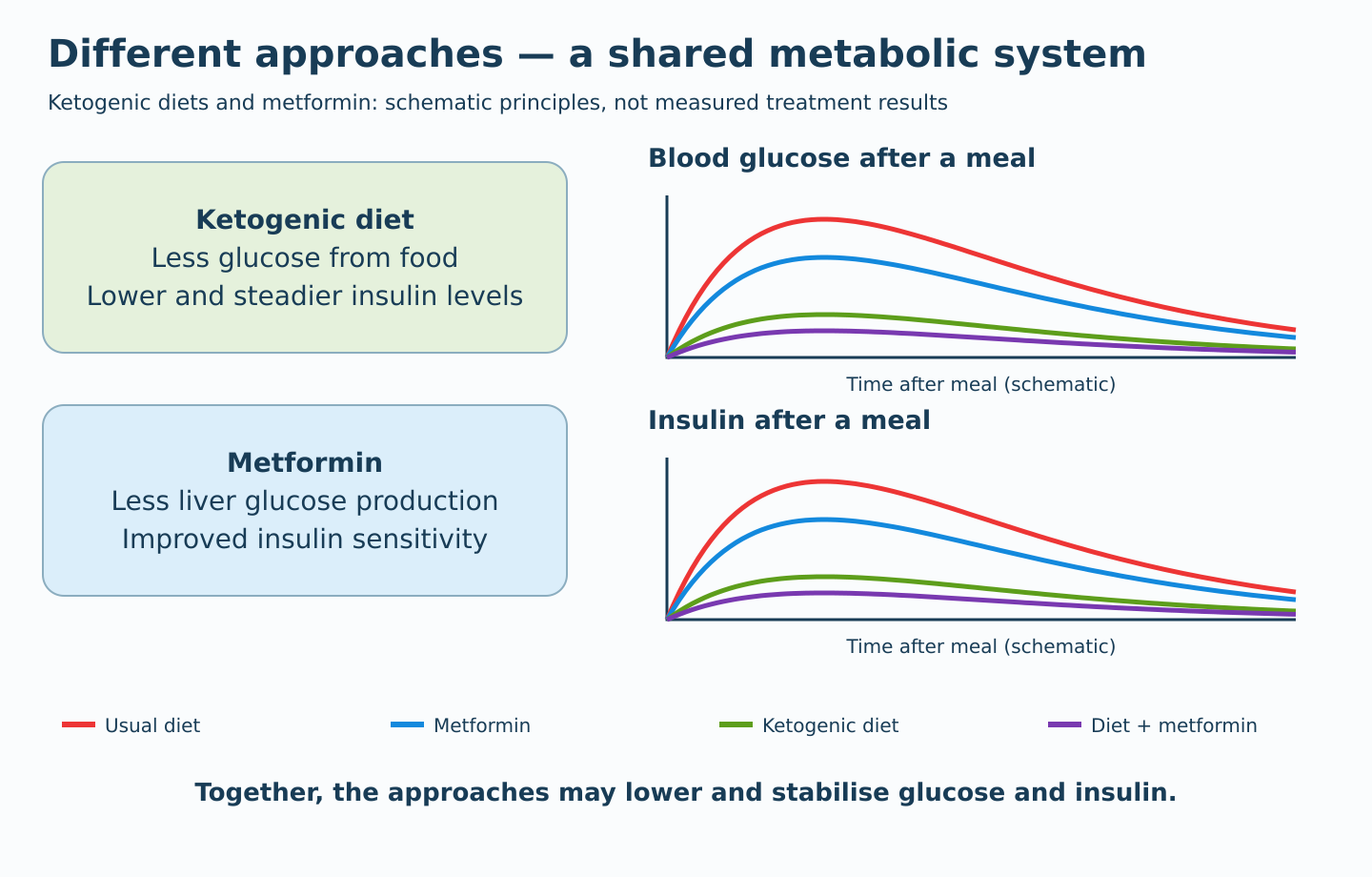
Both blood glucose and insulin affect cancer cell growth and survival. This schematic illustrates how ketogenic diets and metformin influence these levels through different mechanisms. A ketogenic diet reduces glucose supplied by food, while metformin primarily reduces liver glucose production and improves insulin sensitivity. The curves illustrate principles and are not measured treatment results.
Blood glucose has become a bigger issue in cancer care
Blood glucose has traditionally been regarded mainly as a diabetes issue.
In oncology, however, interest is growing in how metabolism affects the successful delivery of cancer treatment.
In January 2025, Chase Doyle published an article in The ASCO Post on treating other medical conditions alongside cancer. It reports on M. Edie Brucker’s presentation at JADPRO Live 2024.
M. Edie Brucker emphasised that poorly controlled diabetes complicates cancer treatment and increases the risk of complications.
She highlighted checking fasting glucose and HbA1c before treatment and reviewing medications in patients taking drugs such as metformin or insulin.
Cancer treatment itself can also raise blood glucose. Corticosteroids, used with several chemotherapy regimens, are a common example.
Brucker explained that, where medically appropriate, she sometimes reduces corticosteroid doses to limit pronounced glucose elevations.
Read Chase Doyle’s ASCO Post article featuring M. Edie Brucker (2025) ↗
Blood glucose is no longer viewed only as a separate diabetes problem. It is a factor to consider when planning and delivering certain cancer treatments.
Metformin is already used preventively with some cancer treatments
A particularly clear example is treatment with drugs inhibiting PI3K/AKT signalling.
This pathway is central both to tumour growth and to the body's insulin and glucose regulation.
Blocking it can cause insulin resistance and markedly elevated blood glucose.
There is an additional problem: rising insulin levels may counteract part of the signalling blockade the cancer drug is intended to produce.
Glucose control has therefore become particularly important with these treatments.
A 2024 international expert consensus recommends preventive metformin for patients with elevated HbA1c in the prediabetes range before treatment with the PI3K inhibitor alpelisib.
Carbohydrate-restricted diets, including ketogenic diets, are also discussed as part of metabolic control.
In October 2026, oncologist Jason Mouabbi described his approach to early glucose control in advanced breast cancer in Targeted Oncology.
He highlighted dietary changes, metformin and regular glucose monitoring, aiming to allow patients to complete cancer treatment without unnecessary interruptions.
Watch Jason Mouabbi’s video on managing hyperglycaemia (2026) ↗
This is a concrete example of glucose and insulin control becoming an active component of cancer treatment.
It raises an interesting question: could more active intervention in glucose and insulin metabolism also bring treatment benefits to patients with normal glucose levels?
Metformin — an old diabetes drug with new possibilities
Metformin has been used for diabetes for more than 60 years and is one of the world's most widely used diabetes drugs.
It primarily reduces liver glucose production and improves insulin sensitivity.
The result is lower blood glucose and, particularly in insulin resistance, lower insulin levels.
Unlike several other diabetes drugs, metformin does not stimulate insulin production. Used alone, it therefore does not normally cause low blood glucose.
Interest in metformin as a possible cancer drug grew in the early 2000s.
Several observational studies found lower rates of certain cancers among people with diabetes taking metformin than among those receiving other diabetes drugs.
Since then, metformin has been investigated alongside chemotherapy, radiotherapy, hormone therapy, targeted drugs and immunotherapy.
How might metformin affect cancer?
Its effects on tumour growth are not confined to one mechanism.
1. Lower glucose and insulin
Metformin reduces liver glucose production and improves insulin sensitivity.
Insulin is more than a blood glucose regulator. It is also a growth signal affecting pathways including PI3K–AKT–mTOR.
High insulin levels may therefore help drive cancer growth.
By reducing elevated glucose and insulin, metformin may influence this signalling.
2. Effects on AMPK and mTOR
Metformin can activate AMPK and reduce mTOR signalling.
AMPK helps cells adjust energy expenditure when energy availability is limited.
mTOR regulates processes including protein synthesis and cell growth and is often overactive in tumours.
These mechanisms have consequently been studied extensively in cancer research.
3. Metformin and tumour glucose dependence
An earlier post discussed why oxygen shortage makes some tumour cells especially dependent on glucose.
Why is glucose so important in cancer?
Solid tumours usually have uneven oxygen delivery.
Near blood vessels, cells can produce substantial energy with oxygen. Further from functioning vessels, oxygen shortage limits this opportunity. Tumour cells there depend on glycolysis, which can produce ATP without oxygen.
Metformin can inhibit mitochondrial energy production. If oxygenated tumour cells consequently need more glucose for energy, competition for glucose within the tumour increases.
The consequences may be greatest for oxygen-poor cells, which are especially dependent on glucose for survival.
Could metformin make other cancer treatments more effective — 1 + 1 > 2?
Combining metformin with other cancer treatments is a particularly interesting possibility.
The idea is straightforward: two treatments targeting different aspects of tumour survival might together have a greater effect than either alone.
1 + 1 > 2?
A 2024 review in Translational Oncology summarised research on metformin combined with chemotherapy, radiotherapy, targeted drugs and immunotherapy.
The authors described several mechanisms that could explain beneficial combination effects.
Metformin affects glucose and insulin metabolism, energy production and growth signalling. Other cancer drugs target DNA, cell division or specific growth signals.
The combination may therefore sensitise tumour cells to treatment.
Several combinations have shown enhanced effects in experimental models.
Clinical studies have also produced interesting findings.
Read the review of metformin in cancer combination therapy (2024) ↗
The question is therefore not only whether metformin has an anticancer effect of its own.
It may be just as important to investigate whether it makes other treatments more effective.
What do clinical studies show?
A meta-analysis published in September 2026 brought together 19 randomised studies involving 3,502 patients.
Researchers assessed metformin added to cancer treatment.
They found:
- Improved objective tumour response: more patients experienced a measurable reduction in tumour size.
- No statistically significant improvement in overall survival.
- An interesting survival signal in a subgroup receiving metformin with platinum-based chemotherapy.
In that subgroup, the observed hazard of death during follow-up was 39% lower with the combination.
Metformin did not increase serious adverse events across the pooled studies.
Read the meta-analysis of metformin as a chemotherapy adjuvant (2026) ↗
These clinical findings tell us two things.
Metformin has not demonstrated a general survival benefit in cancer. However, the findings justify investigating whether certain tumour types and treatment combinations may benefit particularly strongly.
Differences in tumour metabolism may be part of the explanation.
Metformin in integrative cancer care
Metformin is also used in integrative cancer care, where some clinicians prescribe it outside its approved indication — known as off-label use.
Paul Anderson is an American naturopathic practitioner with extensive experience in integrative cancer care.
In the video Can a Diabetes Drug Really Help Fight Cancer?, he explains why metformin has attracted interest alongside established cancer treatments.
He highlights effects on glucose, insulin, AMPK, mTOR, mitochondria and the tumour microenvironment.
Anderson also discusses whether metformin might enhance other metabolic interventions and established cancer treatments.
The video offers an accessible introduction to the reasoning used in integrative cancer care, although several clinical benefits discussed have not yet been established.
Watch Paul Anderson: Can a Diabetes Drug Really Help Fight Cancer? ↗
What doses are used, and what are the adverse effects?
Metformin is a well-established drug with extensive clinical experience.
Diabetes doses range from 500 to 2,000 mg daily. Treatment usually starts at a lower dose and is increased gradually.
Similar doses are used to manage elevated blood glucose during certain cancer treatments.
The large randomised breast cancer trial MA.32 used 850 mg twice daily, a total of 1,700 mg per day.
Doses of a similar order are also used in integrative cancer care, although regimens vary.
The most common adverse effects are diarrhoea, nausea and other gastrointestinal symptoms, often related to dose.
Long-term use may lower vitamin B12 levels.
Kidney function is especially important because metformin is mainly eliminated through the kidneys. It must not be used with severely impaired kidney function.
Severe liver disease, dehydration and serious acute conditions involving oxygen shortage also increase risk.
Lactic acidosis is very rare with appropriate use, but can be life-threatening.
Metformin is therefore relatively well tolerated, but kidney function, other illnesses and concurrent medications always need to be considered.
Ketogenic diets and metformin — could the combination have a greater effect?
An earlier post discussed how ketogenic diets reduce carbohydrate intake and usually lower insulin and blood glucose.
Ketogenic diets and cancer — what does the research show?
Metformin affects glucose metabolism differently, primarily by reducing liver glucose production and improving insulin sensitivity.
This makes the combination biologically interesting.
A ketogenic diet reduces glucose supplied by food, while metformin affects the body's own glucose regulation.
These are two approaches to the same metabolic system.
However, blood glucose is tightly regulated. In people with normal glucose levels, metformin usually produces only limited additional glucose lowering.
It has therefore not been shown that the combination can restrict tumour glucose availability enough to improve survival.
Effects on insulin, growth signalling and tumour energy metabolism may nevertheless be important.
This makes the combination an interesting research question, particularly alongside established cancer treatments.
What can we conclude?
Blood glucose and insulin control have become increasingly important in modern cancer care.
Metformin is already used to prevent and treat high blood glucose during certain targeted cancer treatments.
Clinical practice nevertheless remains focused mainly on avoiding hyperglycaemia and ensuring patients can complete their cancer treatment.
The wider question is whether more active intervention in glucose and insulin metabolism could improve treatment effectiveness itself.
Metformin has several properties that make it interesting here.
It affects blood glucose, insulin, cellular growth signalling and, under certain conditions, energy production.
Clinical studies have not established a general survival benefit, but there are positive signals with some treatment combinations.
Perhaps the greatest potential lies in combining treatments that attack tumour survival from different directions, rather than using metformin alone as an anticancer drug.
This is the idea behind 1 + 1 > 2.
To understand which combinations may work, we also need a better understanding of tumour metabolism, particularly the interaction between oxygen supply, glucose dependence and energy production.
Future articles will examine other substances affecting tumour metabolism and whether complementary approaches can reinforce one another.
What would you like to know more about?
Do you have questions about metformin, blood glucose, insulin or other metabolic strategies in cancer?
Please leave a comment.
If you find this article interesting, please like and share it.
Sture Hobro
Linbro Therapeutics AB
References and further reading
1. Doyle C (2025). Managing Comorbidities in Oncology: Practical Strategies for Optimized Patient Care. The ASCO Post. Read the article
2. Gallagher EJ et al. (2024). Managing hyperglycemia and rash associated with alpelisib: expert consensus recommendations using the Delphi technique. npj Breast Cancer. Read the article
3. Llombart-Cussac A et al. (2024). Preventing alpelisib-related hyperglycaemia in HR+/HER2−/PIK3CA-mutated advanced breast cancer using metformin (METALLICA). eClinicalMedicine. Read the study
4. Mouabbi J (2026). Managing Hyperglycemia in PIK3CA-Mutated HR+/HER2-Negative Advanced Breast Cancer. Targeted Oncology. Watch the video
5. Evans JMM et al. (2005). Metformin and reduced risk of cancer in diabetic patients. BMJ. Read the study
6. Dowling RJO, Goodwin PJ, Stambolic V (2011). Understanding the benefit of metformin use in cancer treatment. BMC Medicine. Read the article
7. Sonveaux P et al. (2008). Targeting lactate-fueled respiration selectively kills hypoxic tumor cells in mice. Journal of Clinical Investigation. Read the study
8. Metformin as anticancer agent and adjuvant in cancer combination therapy: Current progress and future prospect (2024). Translational Oncology. Read the review
9. Goodwin PJ et al. (2022). Effect of Metformin vs Placebo on Invasive Disease–Free Survival in Patients With Breast Cancer: The MA.32 Randomized Clinical Trial. JAMA. Read the study
10. Bin Saddiq BW et al. (2026). Revisiting metformin as a chemotherapy adjuvant: a systematic review and meta-analysis based on recent randomized-controlled trials. Frontiers in Oncology. Read the meta-analysis
11. Anderson P (2025). Can a Diabetes Drug Really Help Fight Cancer? Watch on YouTube
This article provides research information and educational support. Metformin is not an established general cancer treatment. Decisions about medication and changes to cancer treatment should be made with the responsible physician.
Comments are public. Please do not include sensitive health information about yourself or others. Comments are reviewed before publication.
Comments
How your comment is handled
Linbro Therapeutics AB is responsible for comments. Your display name, text and date are published if your comment is approved. Your ChatGPT identity is used for sign-in and spam prevention, but is not shown publicly. Pending comments are deleted within 90 days. Approved comments remain until removed or the comment service is discontinued. Do not include sensitive health information. Contact sture.hobro@linbrotherapeutics.com to request removal or ask about how comments are handled.