
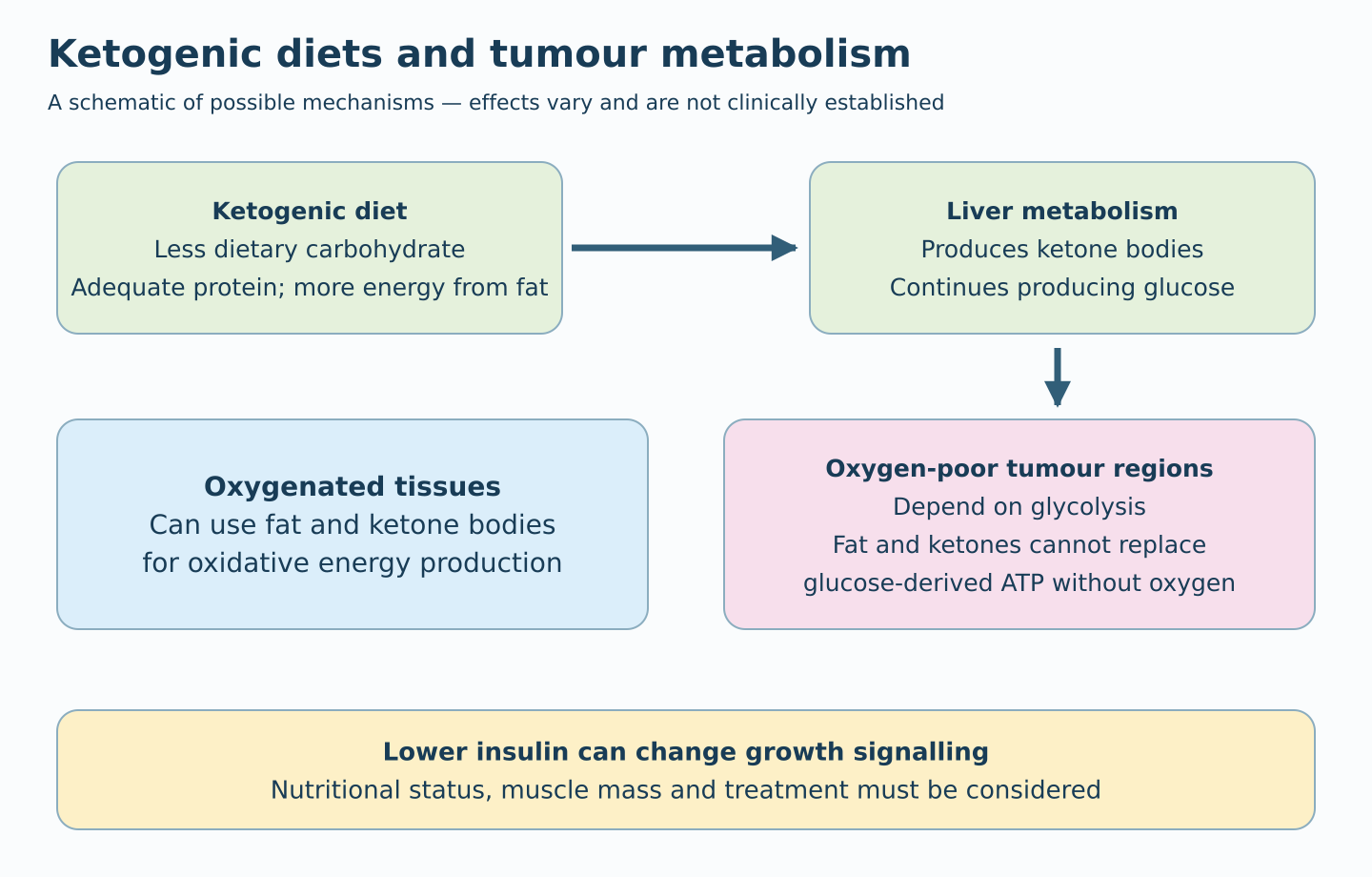
Schematic illustration of how a ketogenic diet may affect glucose, ketone bodies and tumour metabolism. Effects on tumours vary and have not yet been clinically established.
What is a ketogenic diet?
A ketogenic diet severely restricts dietary carbohydrates and provides most energy from fat, while maintaining adequate protein intake.
When carbohydrate availability falls, blood glucose and insulin levels usually decrease. The liver then begins producing ketone bodies from fat.
Ketone bodies provide an alternative fuel for organs including the brain, heart and muscles.
Importantly, ketone bodies and glucose are not interchangeable energy sources under all conditions. Extracting energy from ketone bodies requires oxygen. Glucose, by contrast, can supply energy without oxygen and also support biosynthesis and redox balance in ways that ketone bodies cannot fully replace.
This difference is particularly interesting when studying tumour metabolism.
Why might a ketogenic diet affect tumours?
Many solid tumours have poorly functioning blood vessels. Oxygen and nutrient delivery is uneven, and parts of the tumour develop substantial oxygen shortage, known as hypoxia.
Where oxygen is readily available, tumour cells can produce energy efficiently through oxidative phosphorylation (OXPHOS). As oxygen availability decreases, cells become increasingly dependent on glycolysis, which can use glucose to generate energy without oxygen.
This creates an important metabolic difference between tumour regions.
Cells in oxygen-poor areas cannot simply replace glucose with fat or ketone bodies as an energy source, because these fuels require oxygen to support ATP production.
By reducing glucose availability, a ketogenic diet may therefore create metabolic stress, particularly in oxygen-poor tumour regions where cancer cells are often especially resistant to several established treatments.
Meanwhile, healthy tissues can use fat and ketone bodies for energy.
A ketogenic diet also affects other biological systems. Lower insulin levels may change growth signalling, and ketone bodies have been studied for possible effects on inflammation, oxidative stress and cellular redox balance — processes important to cancer cell survival and growth.
However, tumours differ. Some cancer cells can use ketone bodies or fatty acids, particularly when oxygen is available, and a few tumour types have a good oxygen supply. The same effect cannot therefore be expected across all cancers.
Another important limitation is that a ketogenic diet does not dramatically lower blood glucose. The liver continues producing glucose even when we eat almost no carbohydrates. Many researchers therefore argue that the effects of a ketogenic diet alone on glucose levels and tumour metabolism may be limited…
What do animal studies show?
Ketogenic diets have been investigated in many experimental cancer models.
In numerous studies, researchers have observed slower tumour growth, smaller tumours or longer survival. Some of the most dramatic results have occurred when ketogenic diets were combined with radiotherapy or drugs.
A 2021 systematic review and meta-analysis included 38 animal studies, with 17 contributing to the statistical synthesis. Overall, the findings showed reduced tumour volume and weight and improved survival in experimental animals.
There are also animal studies in which ketogenic diets had no clear effect or even increased tumour growth. These findings need to be assessed in the context of how the experiments were conducted.
In some studies, animals had unrestricted access to energy-dense food, gained fat mass and showed no clear reduction in blood glucose. Others used tumour models with a particularly strong ability to use fatty acids as fuel.
It is therefore important to distinguish the effects of a high-fat diet from the metabolic state a ketogenic diet aims to achieve: lower glucose and insulin levels and higher ketone concentrations.
Taken together, animal experiments provide very strong reasons to continue investigating ketogenic diets and glucose lowering as possible additions to established cancer treatment.
Read the animal-study meta-analysis (2021) ↗
What do human studies tell us?
Several recent clinical studies have investigated ketogenic diets alongside established cancer treatment.
A recurring finding is that many patients can follow the diet with acceptable tolerability, particularly with support from dietitians and healthcare professionals. Maintaining a strict ketogenic diet over a long period can nevertheless be difficult.
Four studies are particularly interesting.
Glioblastoma — promising survival findings (2025)
Glioblastoma is an extremely aggressive brain tumour with a very poor prognosis.
A study published by Kiryttopoulos and colleagues in 2025 followed 18 patients with glioblastoma.
Six patients managed to follow the ketogenic diet for more than six months. Four of these survived for at least three years, compared with only one of the twelve patients who could not maintain the diet for as long.
This corresponds to three-year survival of 67% versus 8%.
The difference is striking, although the patient numbers are small.
The study also shows that the diet is not easy to follow. Only one-third of the patients maintained it over the longer term.
Patients who are well enough and able to follow a demanding diet for a long time may also differ from other patients in disease course and general health. The study was not randomised and cannot establish that the diet caused the improved survival.
Read Kiryttopoulos and colleagues (2025) ↗
A ketogenic diet alongside standard treatment (2025)
Another study, published in 2025, investigated a ketogenic diet alongside standard treatment in 17 patients with newly diagnosed glioblastoma.
Patients followed a strict ketogenic diet for 16 weeks while receiving established cancer treatment.
All 17 met the study's ketosis criterion on more than half of the study days. None experienced excessive weight loss or serious diet-related adverse effects.
Median survival was reported as 29.4 months from starting the diet.
This is an interesting finding in a disease that usually has a very poor prognosis.
The study was a phase 1 trial, designed primarily to investigate safety and feasibility.
Read the phase 1 glioblastoma study (2025) ↗
A new study — ketogenic diet combined with fasting (2026)
In June 2026, another interesting clinical study in patients with glioblastoma was published.
Researchers investigated an intensive metabolic intervention combining a ketogenic diet with periods of fasting and time-restricted eating, alongside established cancer treatment.
Of the 18 patients who started the intervention programme, 15 achieved the main metabolic-control target during radiotherapy and chemotherapy.
Median survival was 21.5 months in the intervention group versus 14.7 months in the comparison patients.
Three-year survival also differed substantially: 27% versus 7%.
The study also found improvements in reported quality of life and physical activity. Intervention-related adverse effects were considered mild or moderate.
Importantly, patients lost an average of 17% of their body weight. Weight loss was intentional within the protocol, but illustrates why nutritional status and body weight must be monitored carefully.
The findings are promising, but the intervention involved several simultaneous changes and was not randomised. It is therefore impossible to determine how much of the observed survival difference was due to the ketogenic diet itself.
Read the ketogenic diet and fasting study (2026) ↗
A Japanese study in patients with advanced cancer (2023)
In 2023, Egashira and colleagues published long-term follow-up of patients with advanced cancer who had undergone ketogenic dietary therapy at Osaka University.
The study included 55 patients with different advanced cancers. For 53, survival could be compared according to how long they had followed the diet.
Among the 21 patients who followed it for at least twelve months, median survival was 55.1 months, compared with 12 months among the 32 who followed it for a shorter period.
The difference was statistically significant and remained after researchers attempted to adjust for differences in patient characteristics.
This is a remarkable finding.
The study shows a clear association between long-term adherence and longer survival, but cannot reliably determine how much of the difference was caused by the diet.
Read Egashira and colleagues (2023) ↗
Is a ketogenic diet safe during cancer treatment?
Clinical studies so far suggest that ketogenic diets may be feasible in selected patients, often with relatively limited adverse effects.
However, cancer patients are not a uniform group.
Unintentional weight loss, malnutrition and loss of muscle mass are already major problems in many cancers. A diet that makes adequate energy and protein intake more difficult may therefore be unsuitable, even if it produces ketosis.
It is also important to distinguish intentional weight loss within a research protocol from unwanted weight loss in a patient who is already underweight or has lost muscle mass.
A ketogenic diet needs to take account of the patient's nutritional status, cancer type, medications and ongoing treatment.
Ensuring adequate energy and protein intake and monitoring the diet over time are particularly important.
What can we conclude?
After many years of research, there are good reasons to consider ketogenic diets a particularly interesting area of cancer research.
Overall, animal studies show promising antitumour effects, sometimes very strong ones, especially when combined with established cancer treatments.
Clinical studies show that many of the patients investigated can follow a ketogenic diet during cancer treatment without serious diet-related adverse effects. Those who adhere to the diet even appear to feel better during treatment. Several studies also show interesting associations between long-term adherence and longer survival.
We still lack sufficiently large, well-controlled clinical studies to determine reliably which patients benefit and how large any benefit might be.
What makes ketogenic diets especially interesting to me is the opportunity to affect the tumour's metabolic environment: glucose availability, insulin signalling and differences between oxygenated and oxygen-poor tumour regions.
My conclusion is that ketogenic diets deserve considerably more clinical research as possible additions to established cancer treatment.
Although large randomised clinical trials remain lacking, I consider the overall findings promising enough for ketogenic diets to be taken seriously as a possible adjunct in certain cancers.
They are not a proven cancer treatment, but neither should the idea be dismissed simply because large randomised trials are still missing.
What would you like to know more about?
Do you have questions about ketogenic diets, ketones, blood glucose or cancer? Please leave a comment.
In future posts, we can explore why oxygen shortage makes some tumour cells particularly dependent on glucose, and why ketone bodies cannot necessarily replace glucose as fuel in a tumour.
Sture Hobro
This article provides research information, not individual treatment recommendations. Dietary changes during cancer treatment should be discussed with your treating care team.
Comments are public. Please do not include sensitive health information about yourself or others. Comments are reviewed before publication.
Comments
How your comment is handled
Linbro Therapeutics AB is responsible for comments. Your display name, text and date are published if your comment is approved. Your ChatGPT identity is used for sign-in and spam prevention, but is not shown publicly. Pending comments are deleted within 90 days. Approved comments remain until removed or the comment service is discontinued. Do not include sensitive health information. Contact sture.hobro@linbrotherapeutics.com to request removal or ask about how comments are handled.