
One of cancer's most important survival strategies is to prevent apoptosis — the program that normally eliminates damaged or unwanted cells.
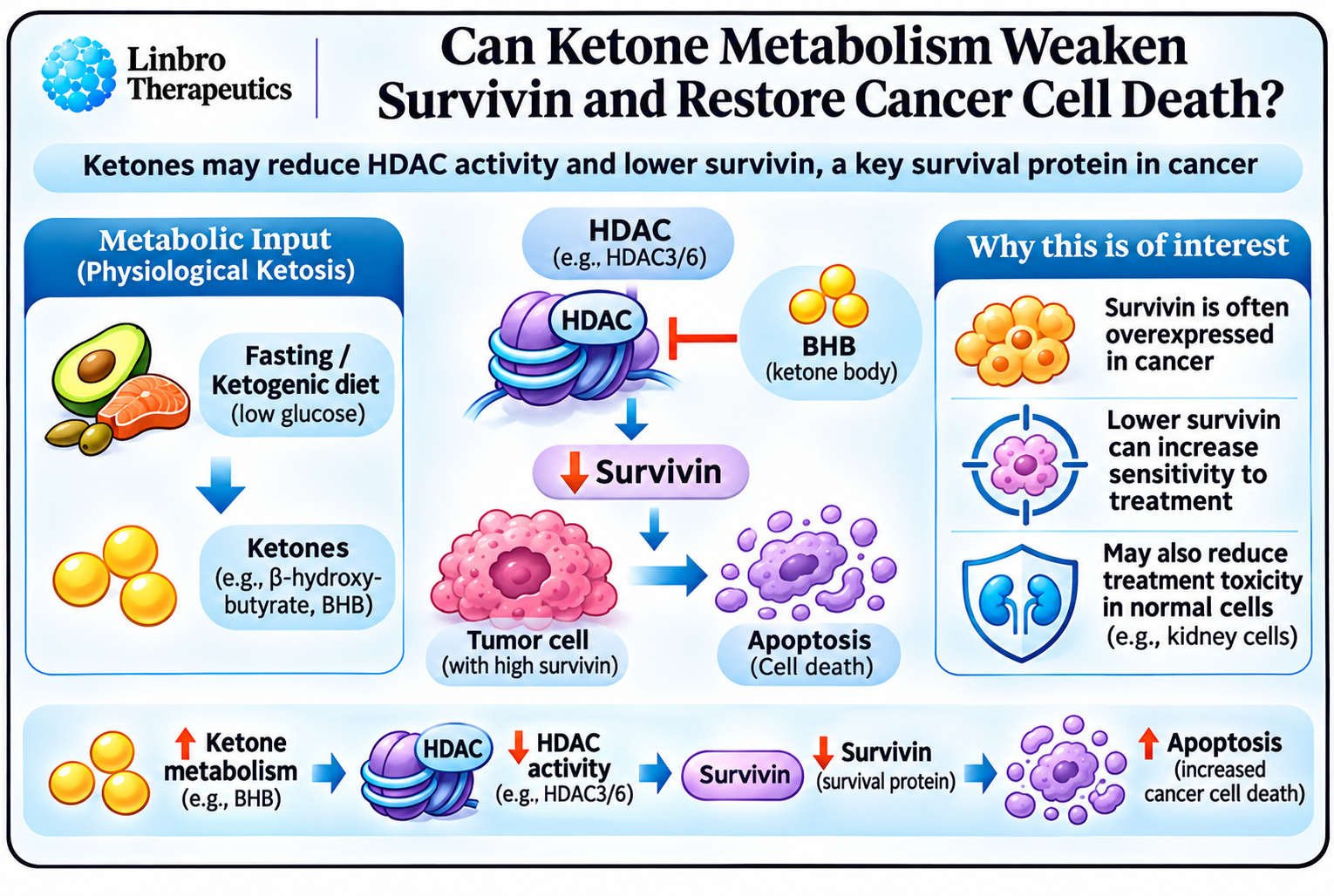
Figure 1. BHB, HDAC regulation, survivin and chemotherapy response. In HepG2 cells, 10 mM BHB was associated with reduced HDAC and survivin expression and enhanced cisplatin-induced apoptosis. A separate kidney-cell experiment reported an HDAC5-related protective effect. The diagram is a mechanistic summary, not a clinical result.
Survivin is part of that resistance. It helps regulate cell division and suppresses pathways leading to cell death. It is frequently overexpressed in cancer and is associated with treatment resistance and poor prognosis. Can ketone metabolism alter survivin and change the way cancer cells respond to chemotherapy?
This note examines a specific HDAC-associated survival pathway. For the broader relationship between ketones and epigenetic regulation, see “Cancer Metabolism and Epigenetics — Can Fuel Availability Change Gene Regulation?”.
Mikami and colleagues (2020) tested this in human liver cancer cells treated with cisplatin. In HepG2 liver cancer cells, they combined cisplatin with beta-hydroxybutyrate (BHB). The experiments used 10 mM BHB, above the level usually reached during nutritional ketosis. The combination increased cisplatin-induced apoptosis and activation of caspase-3 and caspase-8.
BHB reduced expression of HDAC3, HDAC5, HDAC6 and survivin. Experimentally suppressing HDAC3 or HDAC6 also lowered survivin and increased sensitivity to cisplatin, supporting a connection between these enzymes and the survival response.
In separate experiments reported in 2019, the same group found that BHB could reduce cisplatin injury in cultured human kidney epithelial cells, with a different HDAC5-related response.
That contrast is fascinating: in one cell model BHB increased cisplatin-induced cancer-cell death, while in another it protected normal kidney cells. Different tissues and HDAC pathways responded differently to the same metabolite.
Sources: Mikami D et al. (2020). β-Hydroxybutyrate enhances the cytotoxic effect of cisplatin via the inhibition of HDAC/survivin axis in human hepatocellular carcinoma cells. Journal of Pharmacological Sciences 142, 1–8. https://doi.org/10.1016/j.jphs.2019.10.007
Mikami D et al. (2019). β-Hydroxybutyrate, a ketone body, reduces the cytotoxic effect of cisplatin via activation of HDAC5 in human renal cortical epithelial cells. Life Sciences. https://doi.org/10.1016/j.lfs.2019.03.008
Comments
How your comment is handled
Linbro Therapeutics AB is responsible for comments. Your display name, text and date are published if your comment is approved. Your ChatGPT identity is used for sign-in and spam prevention, but is not shown publicly. Pending comments are deleted within 90 days. Approved comments remain until removed or the comment service is discontinued. Do not include sensitive health information. Contact sture.hobro@linbrotherapeutics.com to request removal or ask about how comments are handled.