
Changing fuel availability affects much more than ATP production. Metabolites also influence chemical modifications that regulate chromatin and gene expression. The companion article “Can Ketone Metabolism Weaken Survivin and Restore Cancer Cell Death?” explores a specific HDAC-associated pathway involving survivin and apoptosis; here we take the broader view.
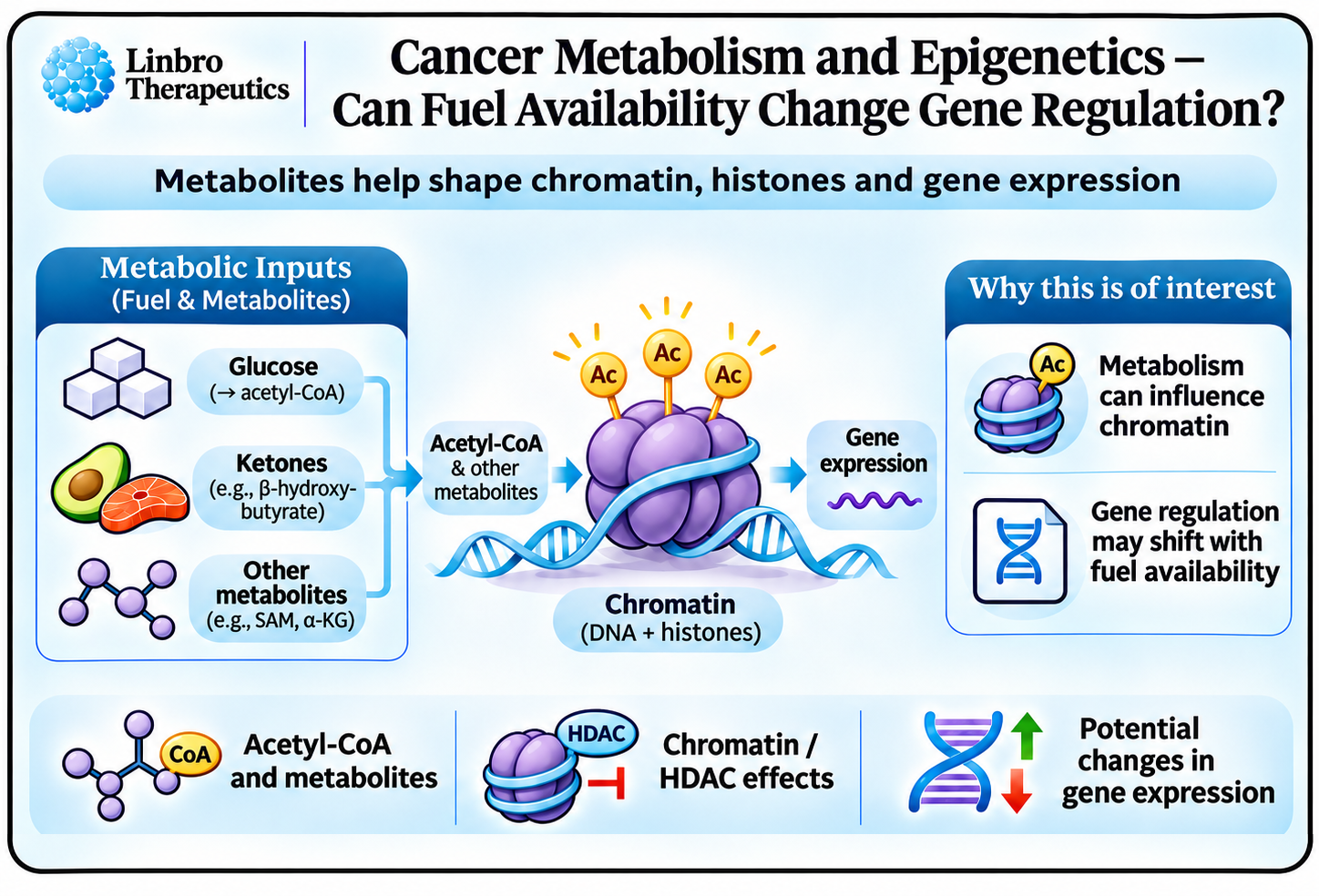
Figure 1. Beta-hydroxybutyrate and epigenetic regulation. BHB can inhibit selected HDAC enzymes and influence histone acetylation and gene expression. The figure summarizes a mechanistic connection between fuel availability and chromatin regulation. For the specific link to survivin and chemotherapy response, see “Can Ketone Metabolism Weaken Survivin and Restore Cancer Cell Death?”.
An important mechanism involves histone deacetylases (HDACs). They remove acetyl groups from histones and other proteins, altering gene regulation. HDAC inhibitors are already used to treat selected cancers.
Shimazu and colleagues (2013) demonstrated that beta-hydroxybutyrate (BHB) inhibits selected HDAC enzymes. In biochemical assays, the reported IC₅₀ values were 5.3 mM for HDAC1, 2.4 mM for HDAC3 and 4.5 mM for HDAC4. HDAC1 and HDAC3 belong to class I, whereas HDAC4 belongs to class IIa. HDAC6 was much less sensitive.
The finding is particularly interesting because the relevant BHB concentrations overlap with those that can occur during sustained fasting. The investigators also observed increased histone acetylation and changes in the expression of genes involved in oxidative-stress resistance, including Foxo3a and Mt2.
These experiments examined epigenetic and oxidative-stress responses, not treatment of cancer. Their importance here is the molecular connection they establish.
What makes this remarkable is that BHB is not a synthetic drug: it is a normal circulating metabolite. Changes in fuel availability can therefore reach the molecular machinery that helps regulate gene expression.
Several HDACs are dysregulated in cancer, and HDAC inhibition is an established therapeutic strategy in some malignancies. BHB acts at millimolar concentrations, whereas many pharmacological HDAC inhibitors are active at much lower concentrations. The two should not be regarded as interchangeable.
HDAC inhibition is not the only connection. BHB can also participate in lysine beta-hydroxybutyrylation, a separate protein modification described in later work. This opens more than one route by which metabolic state can influence gene regulation.
Sources: Shimazu T et al. (2013). Suppression of oxidative stress by β-hydroxybutyrate, an endogenous histone deacetylase inhibitor. Science 339, 211–214. https://doi.org/10.1126/science.1227166
He Y et al. (2023). β-Hydroxybutyrate as an epigenetic modifier: underlying mechanisms and implications. Heliyon 9, e21098. https://doi.org/10.1016/j.heliyon.2023.e21098
Comments
How your comment is handled
Linbro Therapeutics AB is responsible for comments. Your display name, text and date are published if your comment is approved. Your ChatGPT identity is used for sign-in and spam prevention, but is not shown publicly. Pending comments are deleted within 90 days. Approved comments remain until removed or the comment service is discontinued. Do not include sensitive health information. Contact sture.hobro@linbrotherapeutics.com to request removal or ask about how comments are handled.