
Cancer metabolism is often described as the result of oncogenic mutations: altered genes produce altered metabolism. But in the living tumor, the environment also determines which genes are expressed and which metabolic pathways are used. Are we giving the environment enough credit?
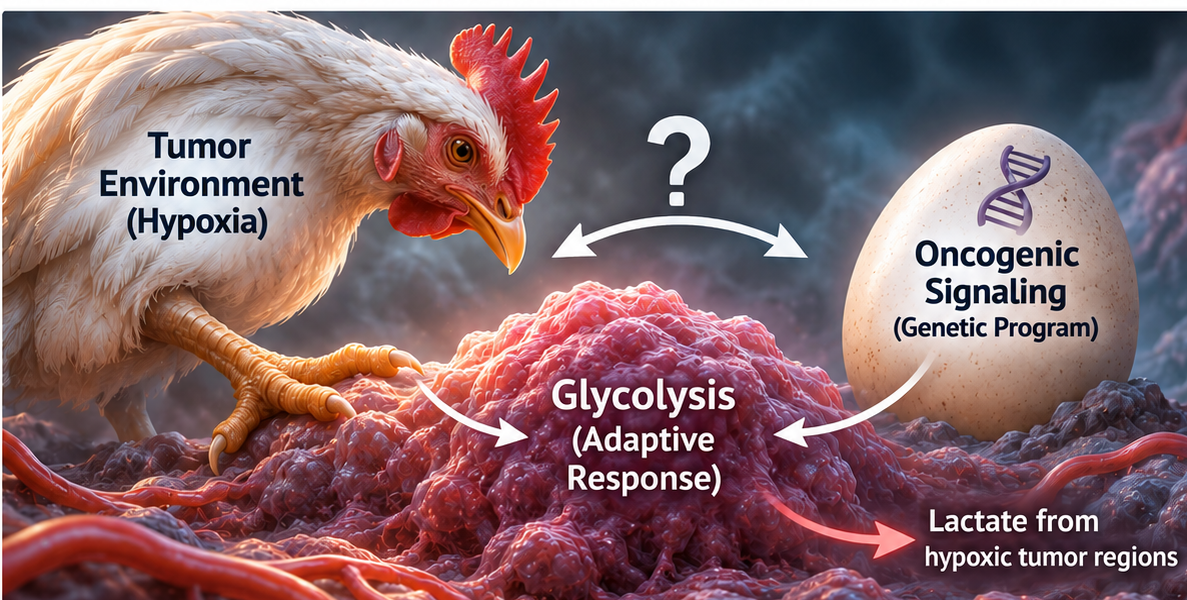
As a solid tumor grows, its blood vessels frequently fail to deliver sufficient oxygen to every region. In the most hypoxic areas, cells must rely heavily on glycolysis for ATP. The response is not passive. Hypoxia-inducible factors (HIFs) and related signals alter gene expression, increasing glucose transport, glycolytic enzyme expression and survival programs.
Oncogenes such as MYC and KRAS also reshape metabolism. Yet the presence of a mutation is not the same as the metabolic behavior we measure in a living tumor. The same genetic capacity can be expressed differently depending on oxygen, nutrients, pH and neighboring cells. Environmental selection and adaptation can strongly influence the phenotype that emerges.
That is the chicken-and-egg problem. Did oncogenic signaling establish the glycolytic phenotype, or did an oxygen-starved environment drive much of the gene-expression program that we now associate with cancer? These processes interact, so a universal order is unlikely.
For therapy, the more useful question may be different: which influence dominates metabolism here and now? Genes define possibilities. The tumor environment constrains which possibilities can actually be used.
If hypoxia creates an important part of the tumor's glucose dependence, changing substrate availability becomes a logical metabolic strategy to investigate—including Therapeutic Hypoglycemia.