
The brain accounts for roughly 20% of resting whole-body energy use in adults. Under a typical diet, glucose is its main fuel.
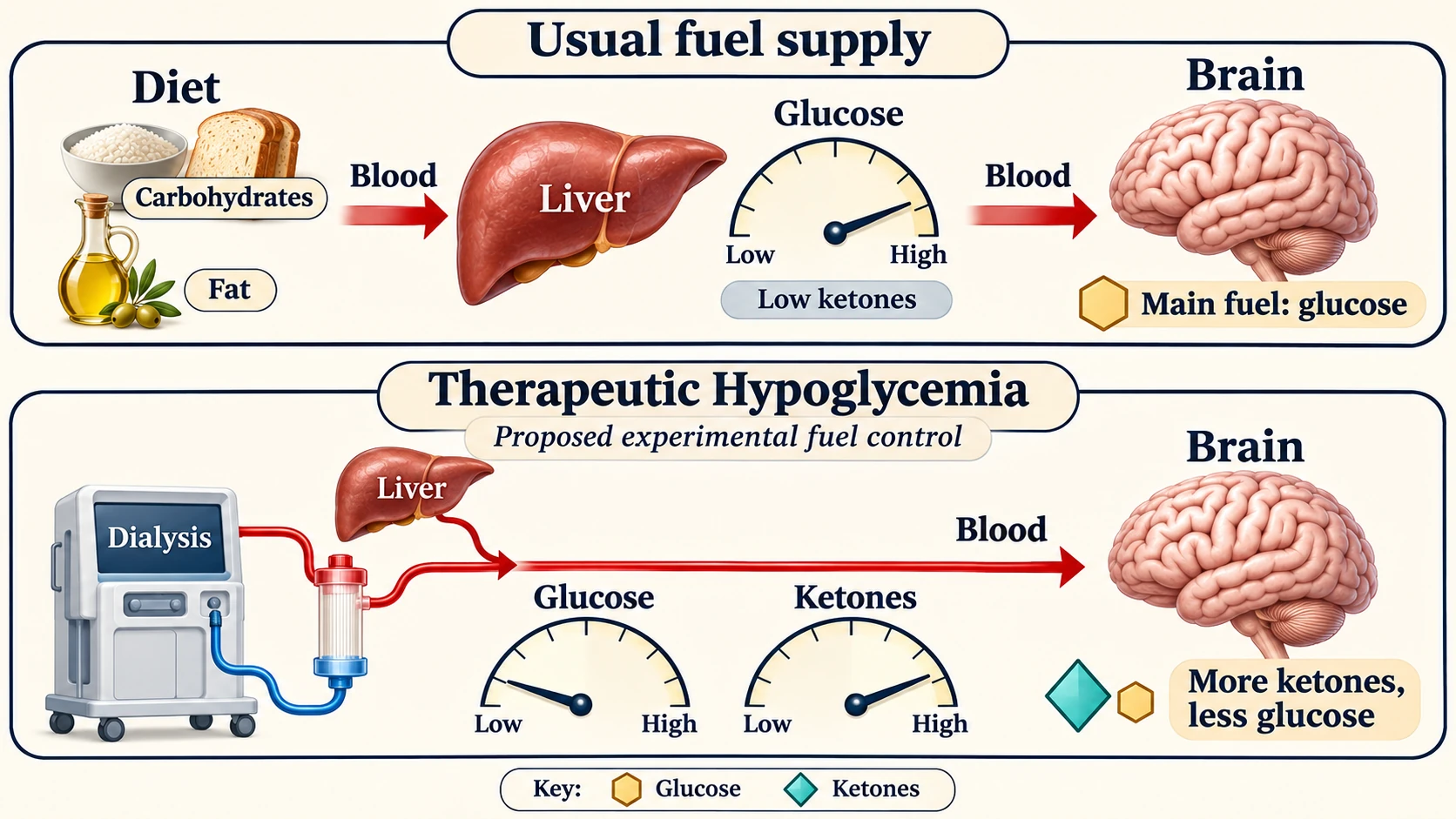
During prolonged fasting, ketones can become the brain’s predominant fuel. Owen and colleagues demonstrated this directly by measuring cerebral fuel uptake after five to six weeks of fasting. This shows what the brain achieved under those conditions, rather than defining a fixed upper limit for ketone use.
Ketones cross the blood–brain barrier through monocarboxylate transporters, including MCT1. Glucose transport across the barrier relies mainly on GLUT1, while neuronal glucose uptake relies largely on GLUT3. Lactate can also serve as an oxidative brain fuel.
In 1972, Drenick and colleagues studied insulin-induced hypoglycemia after prolonged fasting. Nine participants did not develop overt hypoglycemic reactions despite very low glucose; the lowest reported concentration was 0.5 mmol/L. The study also documented increased cerebral ketone uptake in an additional group of fasting participants.
These findings show that alternative fuels and prior adaptation can profoundly change the response to low glucose.
My question is whether controlled delivery of alternative fuels could support cerebral energy metabolism during a short period of Therapeutic Hypoglycemia. The historical studies make this a serious research question. The necessary adaptation, fuel concentrations and duration remain to be established for this proposed application.
Sources
Owen et al. (1967). Journal of Clinical Investigation 46:1589–1595. https://doi.org/10.1172/JCI105650
Drenick et al. (1972). Journal of Clinical Investigation 51:2757–2762. https://doi.org/10.1172/JCI107095