
A tumor cell does not live in a constant bath of nutrients. Its metabolic options depend on where it sits and on whether the nearby vessels are carrying blood at that moment.
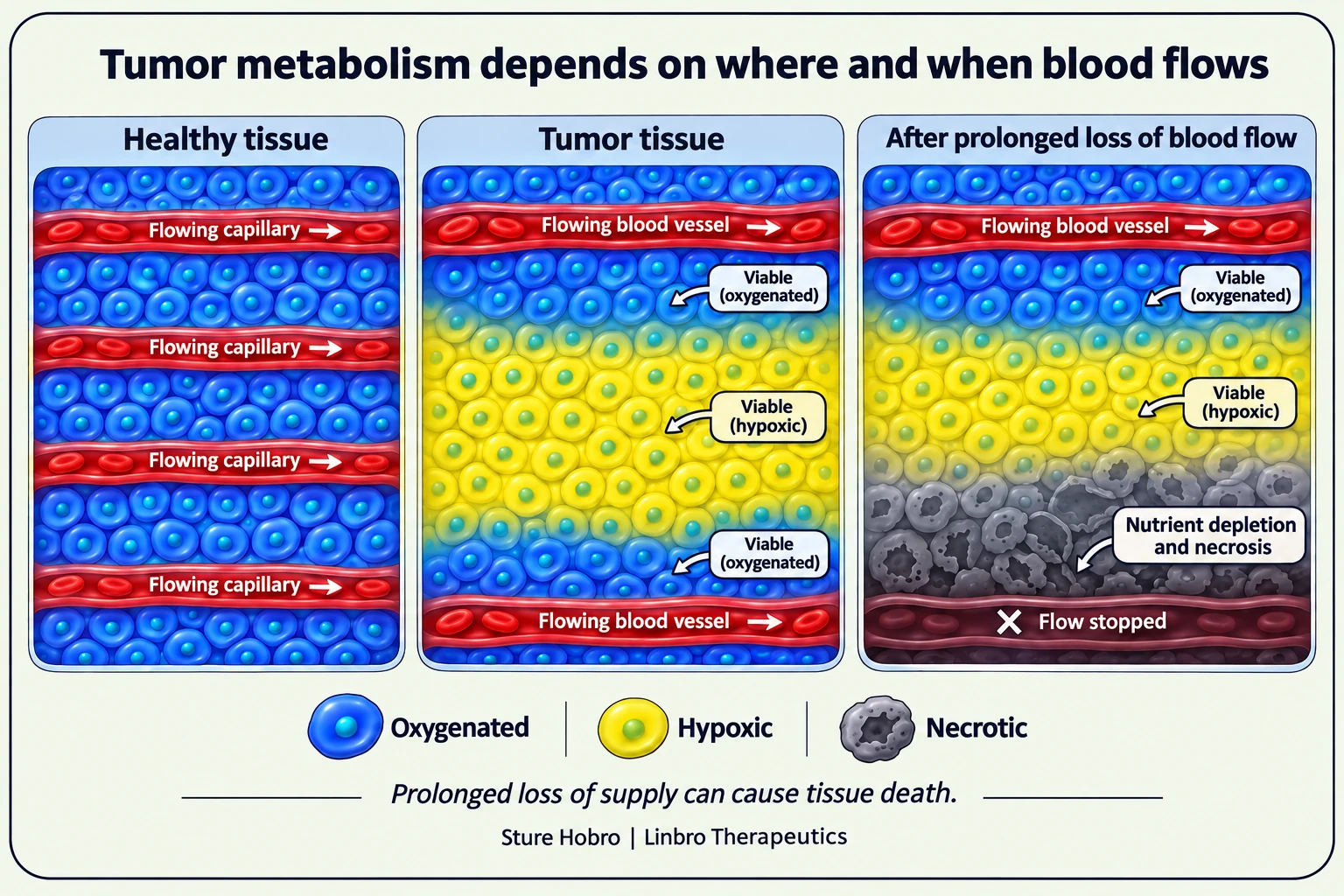
Tumor vessels can be irregular, leaky and poorly perfused. Some regions receive a reasonable supply of oxygen and nutrients, while others are separated from functioning vessels by longer diffusion paths. Oxygen can become limiting while enough glucose remains to support glycolysis. Further away, glucose can become scarce too.
This is the spatial side of the problem. The temporal side is just as important: blood flow can fluctuate, creating episodes of hypoxia and reoxygenation. A cell may therefore face changing conditions without moving at all. A metabolic snapshot can miss this history.
The resulting tissue is a patchwork of opportunities and constraints. Oxygenated cells can use OXPHOS, while severely hypoxic cells rely more strongly on glycolytic ATP. Local consumption, vessel function and diffusion together shape those zones; there is no single distance or concentration ratio that describes every tumor.
My central point is that a large part of metabolic diversity arises from an uneven tumor environment. To understand a tumor's vulnerabilities, we need to ask not only what a cell can consume, but what reaches it, where and when.
Sources
Dewhirst et al. (2008). Cycling hypoxia and free radicals regulate angiogenesis and radiotherapy response.
https://doi.org/10.1038/nrc2397