
What happens when two metabolic interventions with limited effects on their own are applied at exactly the same time? In a striking mouse study, the answer was a much stronger effect on tumor growth.
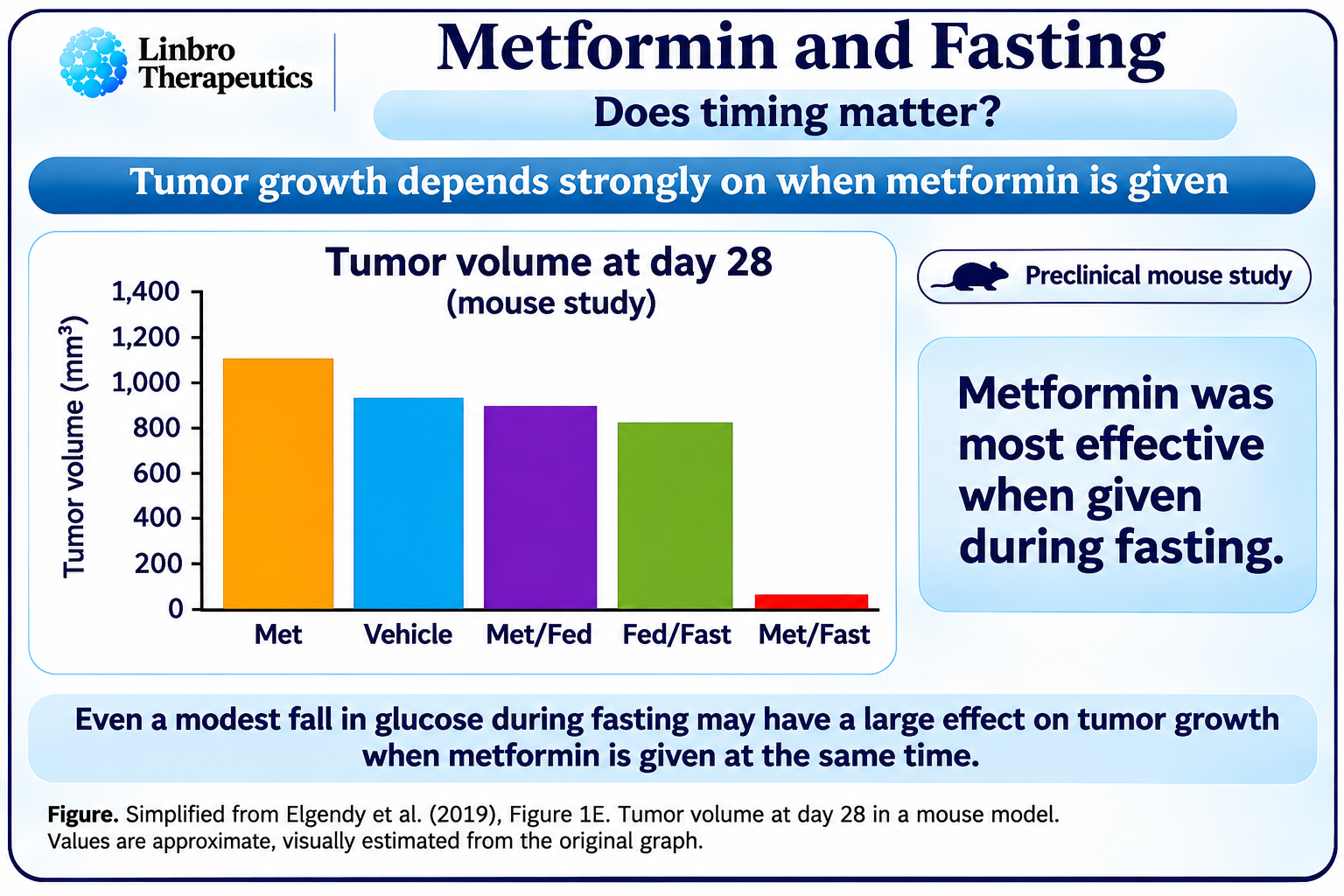
Figure 1. Metformin inhibited tumor growth most strongly when administered during the fasting-associated low-glucose phase.
In this mouse experiment, metformin given during fasting-associated hypoglycemia markedly suppressed tumor growth, whereas dosing during feeding had little effect. The growth curves are adapted from an experimental model; they do not establish a safe hypoglycemic treatment strategy in patients.
Adapted from Elgendy et al. (2019), Figure 1E.
Elgendy and colleagues (2019) investigated metformin together with intermittent fasting in a mouse model. The key observation was not simply that metformin and fasting were both present in the treatment schedule. Metformin reduced tumor growth when it was administered during fasting-induced hypoglycemia — but not when given during the feeding phase.
Low glucose reduces the supply of fuel available to the tumor cell, while metformin makes it harder for the cell's mitochondria to produce energy. Elgendy and colleagues found that these two stresses reinforce each other. Fasting pushes the cancer cell into a more vulnerable state, and metformin then makes it more difficult for the cell to adapt and survive. As a result, tumor cells were more likely to die when metformin was given during fasting than when it was given during the feeding phase. This provides a plausible explanation for why the two interventions were most effective when they were synchronized.
At the molecular level, one of the study's most important findings was that the combination of metformin and fasting-induced hypoglycemia activated the PP2A–GSK3β pathway, reduced levels of the survival protein MCL-1, and promoted tumor-cell death. You don't need to understand these molecular details to appreciate the key finding: the two interventions worked together in a way that neither achieved alone.
This illustrates an important principle: in metabolic therapy, the timing of an intervention may matter as much as its identity. Two treatments administered during the same week are not necessarily equivalent to two treatments acting at the same moment.
It also raises a practical research question. Could a controlled, temporary reduction in blood glucose be synchronized with metformin or conventional cancer treatment? This is one motivation behind the proposed Therapeutic Hypoglycemia approach, in which circulating fuel availability would be deliberately controlled during a treatment window.
The experiment was performed in mice, and metformin has important clinical limitations and contraindications. It does not establish that inducing hypoglycemia with metformin is safe or effective in patients with cancer.
The key observation is not simply that two metabolic treatments were used, but that the low-glucose state and metformin acted together. Their convergence on the same survival pathway helps explain the pronounced loss of tumor metabolic plasticity.
Source: Elgendy M et al. (2019). Combination of Hypoglycemia and Metformin Impairs Tumor Metabolic Plasticity and Growth by Modulating the PP2A–GSK3β–MCL-1 Axis. Cancer Cell 35, 798–815.e5. https://doi.org/10.1016/j.ccell.2019.03.007.
Comments
How your comment is handled
Linbro Therapeutics AB is responsible for comments. Your display name, text and date are published if your comment is approved. Your ChatGPT identity is used for sign-in and spam prevention, but is not shown publicly. Pending comments are deleted within 90 days. Approved comments remain until removed or the comment service is discontinued. Do not include sensitive health information. Contact sture.hobro@linbrotherapeutics.com to request removal or ask about how comments are handled.