
Radiotherapy is one of the most important treatments for solid tumors. Could a ketogenic diet make cancer cells more sensitive to radiation?
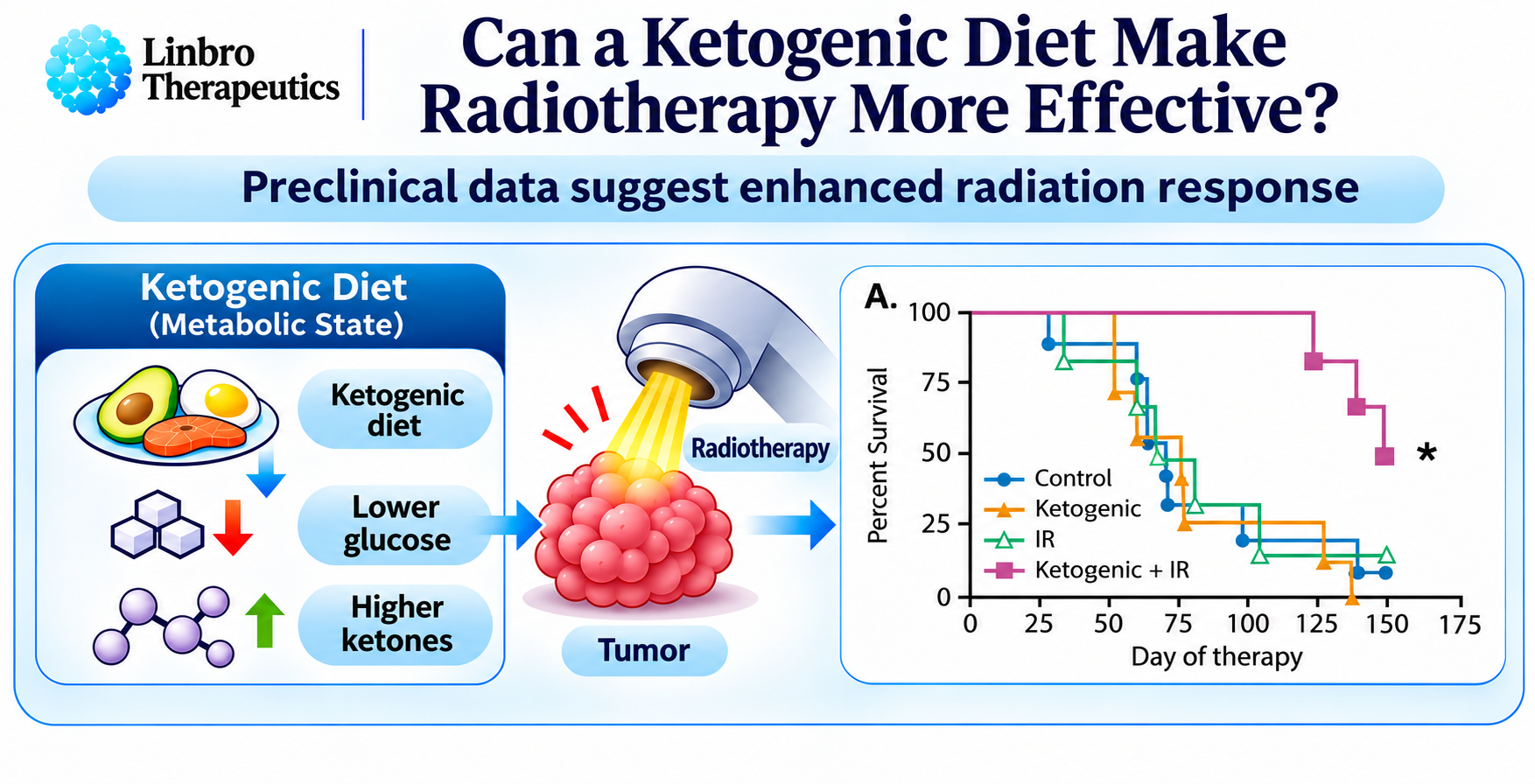
Figure 1. Ketogenic diet enhances radiation response in a pancreatic cancer mouse model. Conceptual illustration incorporating redrawing of the Kaplan–Meier results, Figure 3A of Zahra et al. (2017). In mice bearing human MIA PaCa-2 pancreatic cancer xenografts (5–6 per group), ketogenic diet plus ionizing radiation significantly prolonged survival compared with radiation alone (p < 0.05).
Zahra and colleagues (2017) tested this question in a mouse model of human pancreatic cancer. Their Figure 3 shows how ketogenic diet changed the response to radiation.
A stronger radiation response in mice
The researchers implanted human MIA PaCa-2 pancreatic cancer cells into mice (5–6 animals per group) and compared standard chow, ketogenic diet, radiation alone, and ketogenic diet combined with radiation. The 4:1 ketogenic diet provided about 90% of energy from fat; radiation was delivered as six 2-Gy fractions.
Mice receiving ketogenic diet together with radiation survived significantly longer than mice receiving radiation alone (Figure 3A, p < 0.05). The combination also slowed tumor growth (Figure 3B, p < 0.05). The ketogenic-diet-only group did not show the same survival advantage in Figure 3A.
The ketogenic-diet-treated mice maintained their weight and activity level. In Figure 3C, the diet also appeared to prevent the weight loss observed with radiation and standard chow.
An oxidative-stress mechanism
The researchers also measured markers of oxidative damage associated with lipid peroxidation. Tumors from ketogenic-diet-treated mice showed significantly higher levels than tumors from animals receiving standard chow or radiation alone (Figure 4, p < 0.05).
Radiation damages cells both directly, by breaking DNA, and indirectly, by generating reactive oxygen species. Glucose metabolism also supplies NADPH, which supports the cell’s antioxidant defenses. Higher levels of these oxidative-stress markers therefore support the idea that a ketogenic diet can change the tumor’s redox balance and increase its susceptibility to radiation-induced damage.
A practical challenge in patients
The investigators also ran two small phase I trials in people with locally advanced lung or pancreatic cancer receiving chemoradiotherapy. The primary question was whether patients could tolerate and maintain a strict ketogenic diet during treatment.
Only three of the nine enrolled patients completed their respective protocols. Four stopped because the diet was difficult to follow, and two were withdrawn after dose-limiting adverse events. The lung-cancer group lost an average of 5.6 kg during treatment.
The contrast is striking: a stronger radiation response in the experimental tumor model, but major practical difficulties with the dietary regimen in patients.
The preclinical result deserves further study. Equally important is finding a nutritional approach that patients receiving intensive treatment can realistically maintain.
Source: Zahra A et al. (2017). Consuming a Ketogenic Diet while Receiving Radiation and Chemotherapy for Locally Advanced Lung and Pancreatic Cancer: The University of Iowa Experience of Two Phase I Clinical Trials. Radiation Research 187(6), 743–754. https://doi.org/10.1667/RR14668.1
Comments
How your comment is handled
Linbro Therapeutics AB is responsible for comments. Your display name, text and date are published if your comment is approved. Your ChatGPT identity is used for sign-in and spam prevention, but is not shown publicly. Pending comments are deleted within 90 days. Approved comments remain until removed or the comment service is discontinued. Do not include sensitive health information. Contact sture.hobro@linbrotherapeutics.com to request removal or ask about how comments are handled.