
For patients with advanced cancer, a very low-carbohydrate diet is not just a metabolic intervention. It is also a demanding daily routine. That makes long-term studies interesting for two separate reasons: they may reveal a clinical signal, and they show what patients can actually sustain.
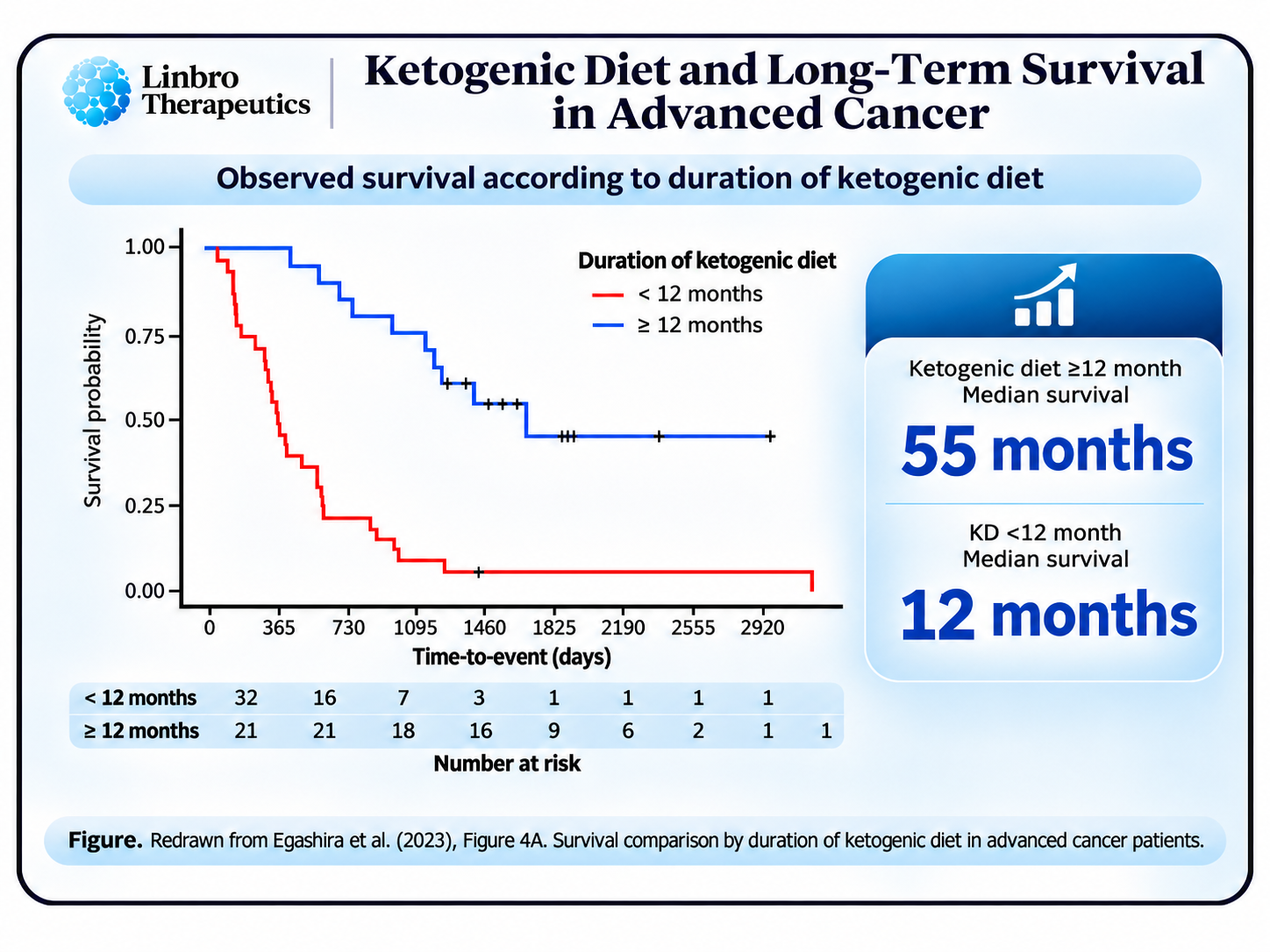
Figure 1. Overall survival by duration of ketogenic diet in 53 patients with advanced cancer: <12 months (n = 32; median 12 months) versus ≥12 months (n = 21; median 55.1 months). The displayed curves reproduce the unadjusted comparison in Egashira et al. (2023), Figure 4A; Figure 4B reports a statistically significant weighted comparison (p < 0.001).
In Figure 4A, Egashira and colleagues (2023) directly compared two groups: patients who followed a ketogenic diet for less than 12 months and patients who maintained it for at least 12 months.
The difference was striking.Patients on the ketogenic diet for less than 12 months had a median survival of 12 months (32 patients), whereas those who maintained the diet for at least 12 months had a median survival of 55.1 months (21 patients).
Figure 4B shows the comparison after inverse probability weighting; the survival difference remained statistically significant (adjusted log-rank test, p < 0.001).
In the 53-patient comparison, 10 of 21 patients in the ≥12-month group died during follow-up, compared with 31 of 32 in the <12-month group. This is a striking observational association.
There is an important design limitation: patients had to survive long enough to remain on the ketogenic diet for 12 months to enter the longer-duration group. This creates a risk of immortal time bias, which weighting for measured baseline characteristics cannot remove. The comparison therefore cannot tell us how much survival was extended by the diet.
It also raises a practical question: does a metabolic intervention need to be maintained for months, or can shorter, more precisely controlled interventions produce useful changes in fuel availability?
The Egashira study highlights the need for controlled studies that account for the timing of dietary exposure, and for investigating adherence as a central scientific question.
Source: Egashira R et al. (2023). “Long-Term Effects of a Ketogenic Diet for Cancer.” Nutrients 15(10), 2334. https://doi.org/10.3390/nu15102334.
Comments
How your comment is handled
Linbro Therapeutics AB is responsible for comments. Your display name, text and date are published if your comment is approved. Your ChatGPT identity is used for sign-in and spam prevention, but is not shown publicly. Pending comments are deleted within 90 days. Approved comments remain until removed or the comment service is discontinued. Do not include sensitive health information. Contact sture.hobro@linbrotherapeutics.com to request removal or ask about how comments are handled.