
Glucose and oxygen dominate most discussions of tumor metabolism, but glutamine deserves special attention. Its role changes with the oxygen available to the cell.
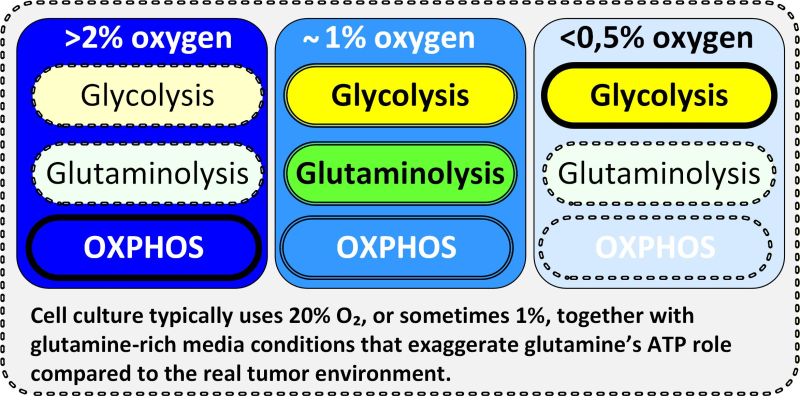
At relatively high oxygen levels (above roughly 2% O₂), oxidative phosphorylation (OXPHOS) generates ATP efficiently using glucose-derived pyruvate.
At moderate hypoxia (around 1% O₂), pyruvate entry into the TCA cycle is restricted through regulation of pyruvate dehydrogenase (PDH). Glutamine sustains TCA-cycle metabolism and, when enough oxygen is available, contributes to ATP production alongside glycolysis.
Under severe hypoxia (below roughly 0.5% O₂), oxidative ATP production becomes strongly constrained. Glycolysis assumes a greater share of the ATP supply, while glutamine remains important for biosynthesis and for pathways linked to cellular redox balance.
The key point: Glutamine remains valuable to tumor cells, but in severely hypoxic regions its role shifts away from bulk oxidative ATP production toward biosynthesis and redox balance. Glucose remains essential for glycolytic ATP production.
The oxygen ranges are illustrative and vary between tumors and cell types.