
Could glutamine become an important ATP fuel at oxygen levels where pyruvate oxidation is already suppressed, but mitochondrial respiration has not yet stopped?
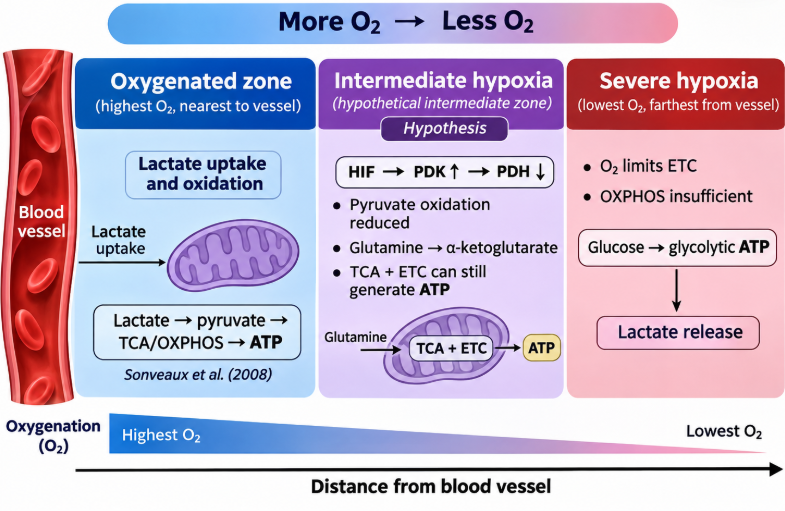
In oxygenated tumor regions, cells can oxidize lactate and other substrates through mitochondrial oxidative phosphorylation. Sonveaux and colleagues (2008) demonstrated lactate-fueled respiration in oxygenated tumor cells, which can spare glucose for more hypoxic regions.
Hypoxia activates HIF signaling and increases PDK activity, inhibiting pyruvate dehydrogenase (PDH). This reduces the conversion of pyruvate into acetyl-CoA. Glutamine enters the TCA cycle through glutamate and α-ketoglutarate, bypassing PDH.
Here is my hypothesis: at intermediate oxygen levels, glutamine-derived carbon can still support oxidative ATP production even after glucose-derived pyruvate oxidation has been curtailed. As oxygen falls further, electron transport itself becomes limiting. At that point glutamine cannot replace the ATP supplied by glucose-dependent glycolysis.
The important unknown is the width and physiological importance of this intermediate oxygen window. It should be tested by measuring substrate oxidation, ATP production and oxygen dependence in living tumors—not inferred from substrate uptake alone.
Source: Sonveaux et al. (2008), J Clin Invest, doi:10.1172/JCI36843; HIF–PDK mechanism discussed as physiological context.