
Hypoxia is not an on–off switch. Between a well-oxygenated region and a severely oxygen-starved region, there may be a metabolic window in which oxygen remains available but glucose-derived pyruvate enters the TCA cycle less readily.
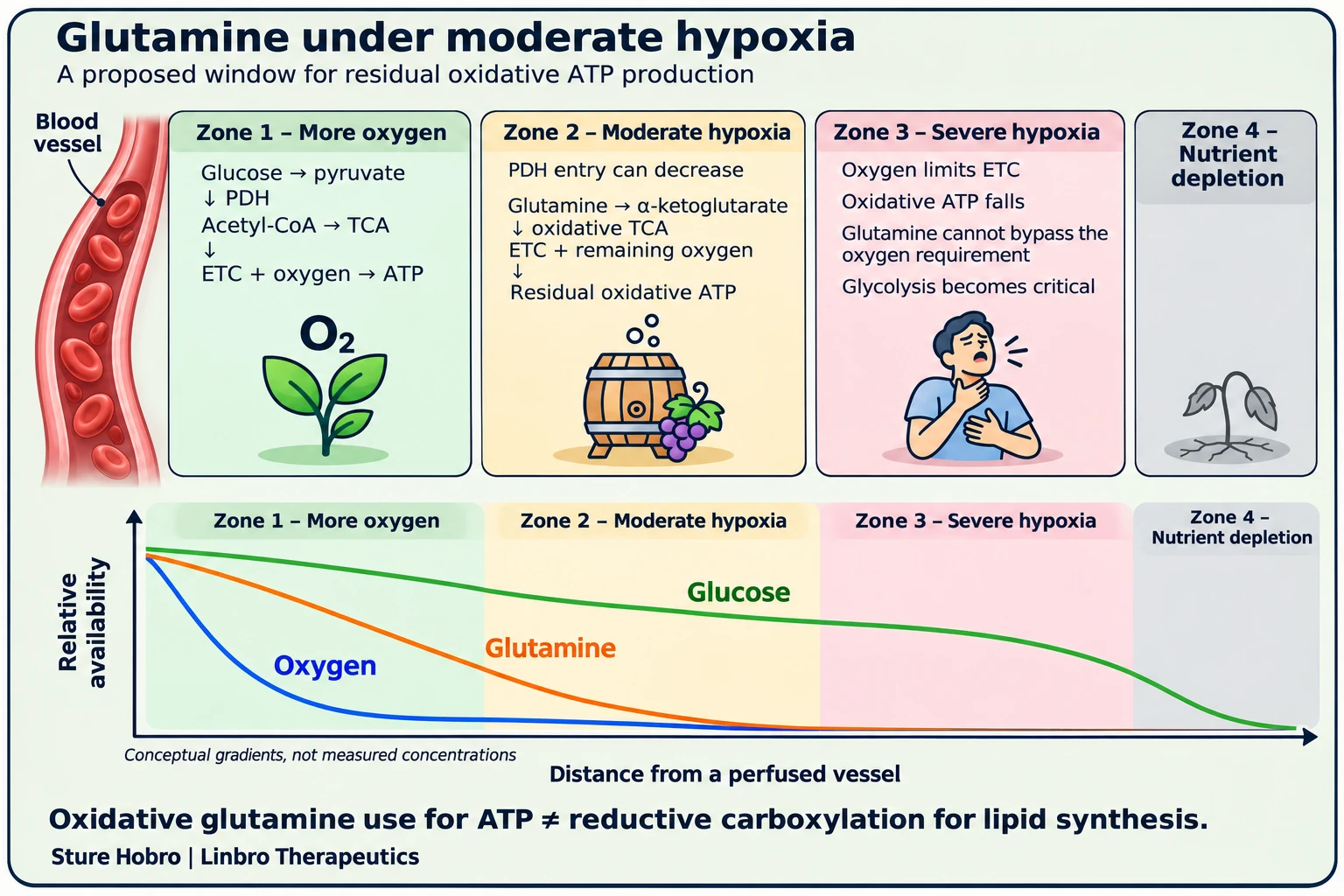
One well-established response to hypoxia is that cells reduce their use of glucose in mitochondrial energy production. This does not necessarily mean that mitochondrial activity stops completely. Instead, it may create a situation where other fuels become relatively more important.
This is where glutamine becomes interesting. My hypothesis is that, in some moderately hypoxic cancer cells, glutamine supports continued oxidative mitochondrial ATP production after the use of glucose-derived pyruvate for this purpose has been restricted.
An important condition remains: the electron transport chain must still have enough oxygen to function. Glutamine is not a way around that limitation. This hypothesis therefore applies only to cells experiencing moderate oxygen restriction, where some oxidative metabolism can still be maintained.
As oxygen levels fall further, the electron transport chain becomes increasingly constrained and oxidative ATP production declines regardless of the carbon source. Glutamine-derived carbon can also support substrate-level phosphorylation in the TCA cycle, but this provides far less ATP than fully coupled oxidative metabolism and cannot be assumed to sustain a severely hypoxic cell.
The question worth testing is therefore whether a metabolic window exists in which glucose contributes less to oxidative ATP production while glutamine can still support mitochondrial respiration. Isotope tracing, together with oxygen consumption and ATP measurements, could help determine whether this occurs in practice.
Sources
Kim et al. (2006). HIF-1-mediated expression of pyruvate dehydrogenase kinase.
https://doi.org/10.1016/j.cmet.2006.02.002
Metallo et al. (2012; online 2011). Reductive glutamine metabolism by IDH1 mediates lipogenesis under hypoxia.
https://doi.org/10.1038/nature10602