
Walking, cycling, strength training and balance exercises can all play a role during and after cancer treatment.
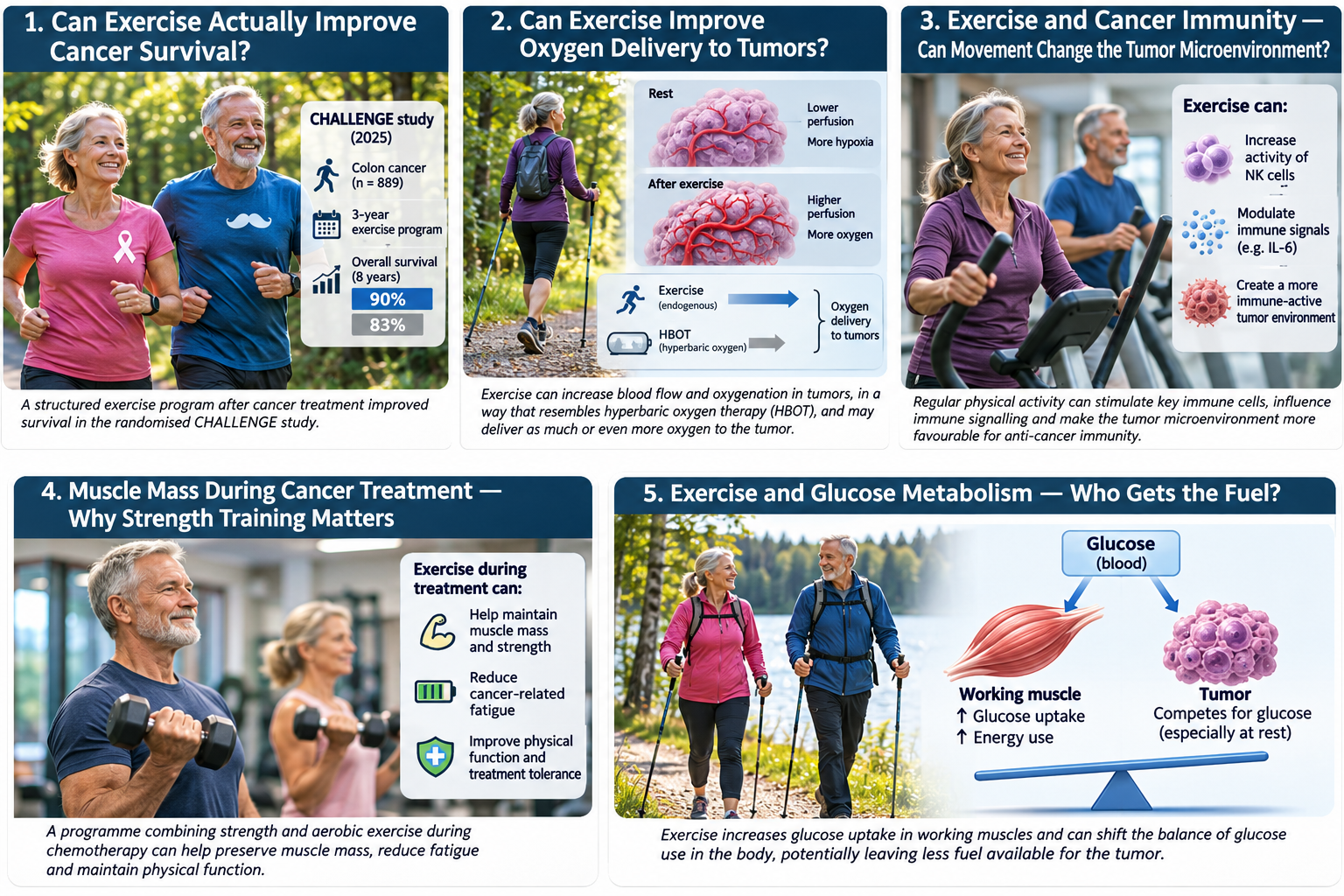
Figure 6. Five perspectives on exercise and cancer: survival, tumor oxygenation, immune function, muscle preservation and glucose metabolism. The comparison with hyperbaric oxygen therapy (HBOT) and reduced glucose availability to established tumors are hypotheses, not demonstrated clinical effects.
When people hear “exercise” after a cancer diagnosis, many imagine gyms, running programmes and impossible targets. That is not what this article is about. The goal is simpler: to maintain strength, mobility and independence while treatment progresses.
Research shows that appropriately adapted exercise can reduce cancer-related fatigue and help maintain fitness, strength and physical function. There is also evidence from a major colon cancer trial that a structured exercise programme after chemotherapy can improve disease-free survival. Movement deserves serious attention — but the right type and amount depend on the person.
1. Walking — the easiest place to start
Walking is inexpensive, familiar and easy to adjust. Five or ten minutes can be a useful beginning for someone who has been inactive. A person with more energy may prefer longer or brisker walks. Short walks several times a day also count.
Nordic walking adds upper-body movement. Poles may offer some support on suitable surfaces, although balance problems or neuropathy can make a supervised indoor option safer.
2. Stationary cycling and cross-trainers — controlled endurance exercise
A stationary bicycle is useful when outdoor walking is difficult, when weather is poor or when a predictable surface feels safer. A recumbent cycle can offer additional support. A cross-trainer engages both arms and legs, but requires more balance and may not suit everyone.
Swimming and water exercise are other options when wounds, infection risk, catheters and treatment instructions permit them.
3. Strength training — protect muscle and daily function
Strength training is especially valuable because cancer and its treatments can reduce muscle mass. Light dumbbells, resistance bands, wall push-ups, seated leg extensions and rising from a chair all provide resistance.
The aim is not maximal lifting. It is to keep the muscles working. A small number of controlled repetitions, with recovery between sessions, can be enough to begin. A physiotherapist can adapt exercises when surgery, bone disease or major weakness is present.
4. Balance and mobility — stay steady and independent
Cancer treatment can affect balance through weakness, dizziness or peripheral neuropathy. Gentle balance practice near a stable support, sit-to-stand movements and comfortable mobility exercises can help maintain confidence in everyday movement.
Yoga, stretching or tai chi may also suit some people, provided positions and loads are adapted. They can complement walking and strength work rather than replace them.
How much exercise is enough?
A practical starting point is to do something manageable and repeat it. For example, begin with five to ten minutes of easy walking once or twice daily, and add simple muscle exercises on suitable days.
A useful guide to moderate intensity is the talk test: you are breathing harder but can still speak in full sentences. General guidance often points toward 150 minutes of moderate aerobic activity a week and strength training on two days. These are goals to work toward, not requirements for someone newly diagnosed or exhausted by treatment.
Some days call for rest or gentler movement. On better days, a longer walk or a little more resistance may feel right. Regularity matters more than forcing a particular target.
When exercise needs to be adapted
Bone metastases or fragile bones can make heavy loads, twisting or high-impact movements unsafe in affected areas. Neuropathy or poor balance increases the risk of falls. Low platelets and severe anemia can also change what is appropriate. Recent surgery, radiation-related skin problems, ports and catheters may require modifications.
Do not exercise through fever or suspected infection. Chest pain, new breathlessness, faintness or unusual dizziness are reasons to stop and seek medical assessment. Ask your oncology team about restrictions, and consider a cancer-rehabilitation physiotherapist when the situation is complicated.
The goal is not to train like an athlete
The point is to preserve the ability to live an ordinary life: walk to the shop, climb stairs, carry groceries, spend time outdoors and do the things that matter to you.
For many people with cancer, a combination of walking or cycling, modest strength training and balance work is a sensible foundation. Start where you are, adapt to treatment and build up when you can.
Research sources
Campbell KL et al. (2019). Exercise Guidelines for Cancer Survivors: Consensus Statement from International Multidisciplinary Roundtable. Medicine & Science in Sports & Exercise 51, 2375–2390. https://doi.org/10.1249/MSS.0000000000002116
Ligibel JA et al. (2022). Exercise, Diet, and Weight Management During Cancer Treatment: ASCO Guideline. Journal of Clinical Oncology 40, 2491–2507. https://doi.org/10.1200/JCO.22.00687
American Cancer Society. Physical Activity When You Have Cancer. https://www.cancer.org/cancer/supportive-care/nutrition-activity-with-cancer/physical-activity-when-you-have-cancer.html
Courneya KS et al. (2025). Structured Exercise after Adjuvant Chemotherapy for Colon Cancer. https://doi.org/10.1056/NEJMoa2502760
Comments
How your comment is handled
Linbro Therapeutics AB is responsible for comments. Your display name, text and date are published if your comment is approved. Your ChatGPT identity is used for sign-in and spam prevention, but is not shown publicly. Pending comments are deleted within 90 days. Approved comments remain until removed or the comment service is discontinued. Do not include sensitive health information. Contact sture.hobro@linbrotherapeutics.com to request removal or ask about how comments are handled.