
For almost a century, the Warburg effect has shaped how we talk about cancer metabolism. But the word “prefer” can hide a more basic question: which fuels and pathways are actually available to a cell, and which are required for its survival?
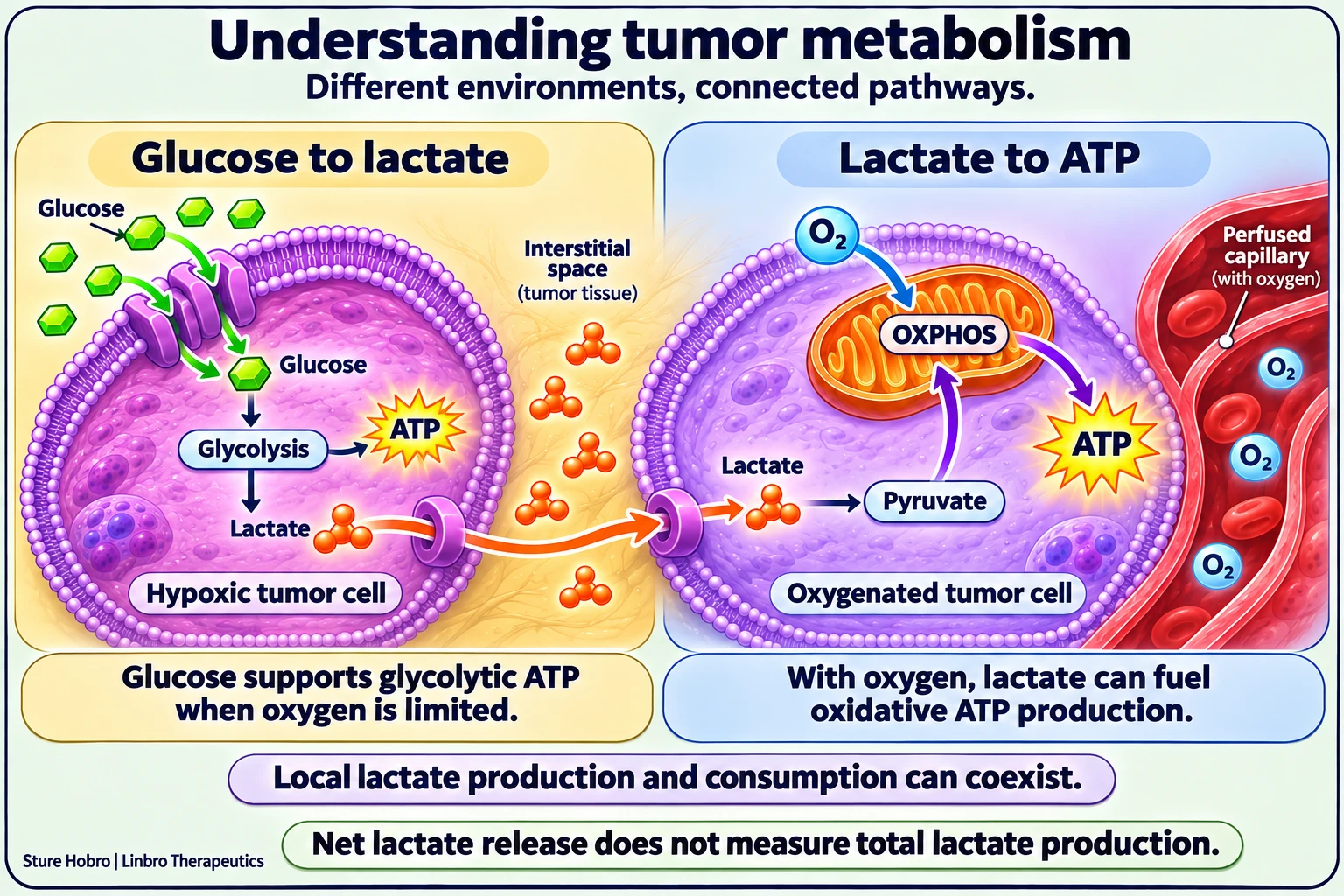
Oxygenated and hypoxic regions coexist. Glucose uptake, lactate release and ATP production are related measurements, but they answer different questions.
Oxygenated tumor cells can take up lactate through MCT1 and use it for respiration, sparing glucose for hypoxic cells. Sonveaux and colleagues (2008) demonstrated that blocking lactate uptake pushed oxygenated cells toward glucose consumption, depriving hypoxic cells of glucose in experimental tumor models.
Local lactate production and consumption can therefore coexist, so net lactate release need not reveal how much lactate is produced inside a tumor.
Under severe oxygen limitation, glycolysis becomes a necessity rather than a preference, even when the mitochondria remain functional. My view is that oxygen limitation deserves a more central place in this discussion. Before concluding that a tumor "prefers" glycolysis, we should ask which metabolic options are actually available under its local oxygen conditions.
Tumor cells survive because they are metabolically opportunistic, not metabolically dogmatic!
Sources
Sonveaux et al. (2008). Targeting lactate-fueled respiration selectively kills hypoxic tumor cells in mice. J Clin Invest 118:3930–3942.
https://doi.org/10.1172/JCI36843
Kim et al. (2006). HIF-1-mediated expression of pyruvate dehydrogenase kinase.
https://doi.org/10.1016/j.cmet.2006.02.002