
A cancer diagnosis raises many questions. Alongside information from healthcare professionals, patients and their loved ones encounter a constant stream of claims about diet, exercise, fasting, supplements and alternative treatments. It is not always easy to tell what is supported by research, what remains uncertain and what conclusions can actually be drawn.
I started this blog to offer a more considered perspective on these questions. I have many years of experience in medical technology development and a particular interest in tumour metabolism — a field I estimate I have now spent more than 25,000 hours studying.
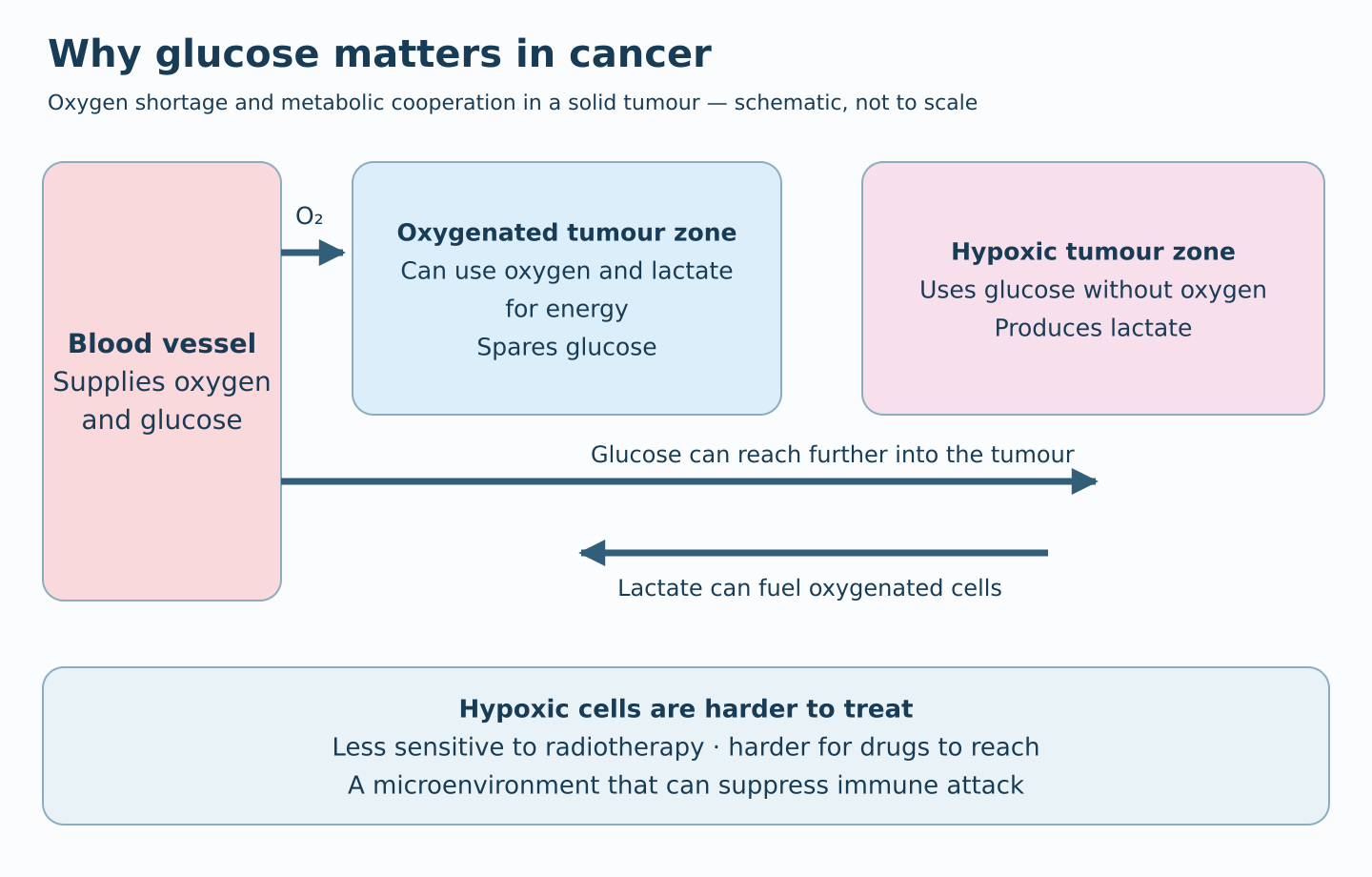
Schematic illustration of metabolic zonation in a solid tumour.
What can you expect?
I will write about research on cancer, metabolism, diet and lifestyle. My aim is to make complex questions understandable without drawing conclusions that go beyond the evidence. When discussing research findings, I provide sources, describe study limitations and highlight questions that remain unanswered.
A central principle is to distinguish laboratory findings from effects that have actually been shown to help patients. An effect in cultured cancer cells or experimental animals is a reason to investigate further; it does not establish that the same intervention is safe or effective in humans.
At the same time, a lack of sufficient studies does not mean an idea has been disproved. What matters is clearly distinguishing what we know, what we have reason to investigate and what remains speculation.
Science advances step by step. Individual studies can be fascinating and promising, but rarely provide the whole answer.
Knowledge to support conversations with your care team
I hope these articles will help you understand research and formulate your own questions to take to your care team. You should be able to recognise both opportunities and limitations without needing specialist knowledge to follow the reasoning.
The blog provides general information and a basis for better-informed conversations. Individual medical assessment, diagnosis and treatment remain the responsibility of treating healthcare professionals.
What would you like to know more about?
Do you have questions about what I write, or suggestions for future topics? Please use the comments section. Questions and constructive discussion are very welcome.
Welcome along.
Sture Hobro
Comments are public. Please do not include sensitive health information about yourself or others. Comments are reviewed before publication.
Comments
How your comment is handled
Linbro Therapeutics AB is responsible for comments. Your display name, text and date are published if your comment is approved. Your ChatGPT identity is used for sign-in and spam prevention, but is not shown publicly. Pending comments are deleted within 90 days. Approved comments remain until removed or the comment service is discontinued. Do not include sensitive health information. Contact sture.hobro@linbrotherapeutics.com to request removal or ask about how comments are handled.