Cancer's treatment-resistant cells run on glucose. We can take it away — and give the brain something else to run on.
The problem. Most cancer patients respond to treatment. Most eventually stop. Treatment does not so much fail as select: it clears the sensitive cells and leaves the resistant ones, concentrated in the low-oxygen regions where radiation works worst and drugs arrive last. Without oxygen those cells depend on glucose. Roughly 10 million people die of cancer each year, most of them at this stage.
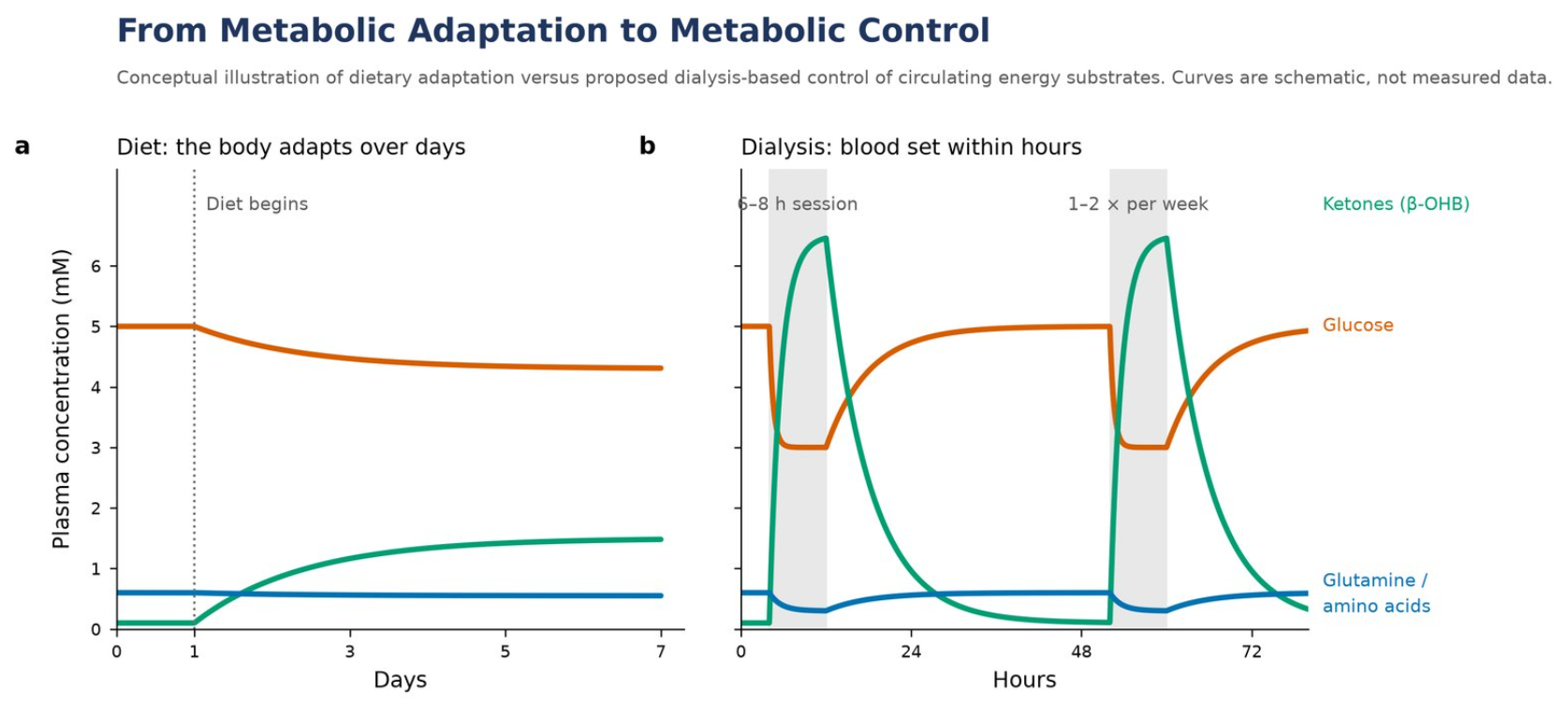
The idea is not new. The delivery is. Ketogenic diets slow tumour growth in animals and improve the response to radiation. In humans the medical ketogenic diet required to reach that state is recognised as hard to sustain — and even when it is sustained, it moves blood glucose by only about 15% and raises ketones to 1–2 mM. The dietary route does not reach the metabolic state the hypothesis requires.
Why dialysis, and why only dialysis. Dialysis is a clamp on blood composition: you set the dialysate, the plasma follows. Within a single session we can lower glucose, raise ketones so the brain keeps a usable fuel, lower glutamine, and hold sodium, potassium and pH exactly where we choose — all at once.
That is not a convenience. Holding beta-hydroxybutyrate at 5–8 mM for eight hours requires on the order of 600–800 mmol of it. Delivered as a sodium salt, that is 600–800 mmol of sodium against a normal daily intake of 100–200. No infusion can do it. A dialysis circuit removes the counter-ion and base load in the same session that delivers the ketone. This is the one route to the target.
Why ketones and not another fuel. The substitute fuel has to be one normal tissue can use and the tumour cannot. Lactate and acetate both fail that test: circulating lactate is a documented oxidative substrate in human lung tumours (Faubert, Cell 2017) and a major source of citric-acid-cycle carbon in vivo (Hui, Nature 2017), and acetate oxidation has been validated directly in brain tumour patients (Mashimo, Cell 2014), which rules it out for glioblastoma in particular. Ketones are the candidate precisely because ketolytic capacity is reduced in many tumours. Fuel selection is part of the invention, not a detail of the formulation.
There is human precedent for the target. Drenick and colleagues (J Clin Invest 1972) gave insulin to subjects after two months of fasting, with plasma beta-hydroxybutyrate at 8 mM. Blood glucose fell as low as 0.5 mmol/L without hypoglycaemic symptoms, while arteriovenous measurements showed the brain taking up ketones as its glucose uptake fell. Whether that protection can be produced acutely, rather than after weeks of adaptation, is the central question our phase I is designed to answer.
Controlled, monitored, reversible. Six- to eight-hour sessions, once or twice weekly, alongside radiation, chemotherapy or immunotherapy. Continuous glucose monitoring, stepwise dose escalation with predefined stopping rules, and reversal within minutes by adjusting the dialysate and giving intravenous glucose. A diet cannot be switched off. A drug has a half-life. And because the clinic administers it, the burden that makes the diet hard to sustain does not carry over.
First readout. FDG-PET before and after a course of sessions, both performed at normalised plasma glucose: does controlled glucose lowering change tumour glucose uptake?
Why now. The machines, the catheters, the dialysis units and the trained teams already exist. Approved dialysis fluids are sufficient to demonstrate the effect, which keeps regulatory risk low. A dedicated fluid composition and a dedicated monitor are the patentable assets and the second stage.
The ask. USD 3–5M to first-in-human proof of mechanism. Metabolic signal at around six months, early efficacy signals at 12 to 24 months. Initial indications are recurrent glioblastoma and advanced pancreatic cancer.
Sture Hobro, CSO — 30+ years in dialysis, inventor, five launched medical products in the dialysis market (Gambro, Baxter Vantive)
Scientific publication
Hobro et al. (2022). Dialysis as a Novel Adjuvant Treatment for Malignant Cancers. Cancers, 14, 5054.
Contact & collaboration
Sture Hobro
Founder, Linbro Therapeutics AB
For research discussions and potential collaborations:
Acknowledgement
With thanks to Kyle Laney for helping communicate these ideas clearly and accessibly.
To contact Kyle about his work: kylelaney2025@gmail.com